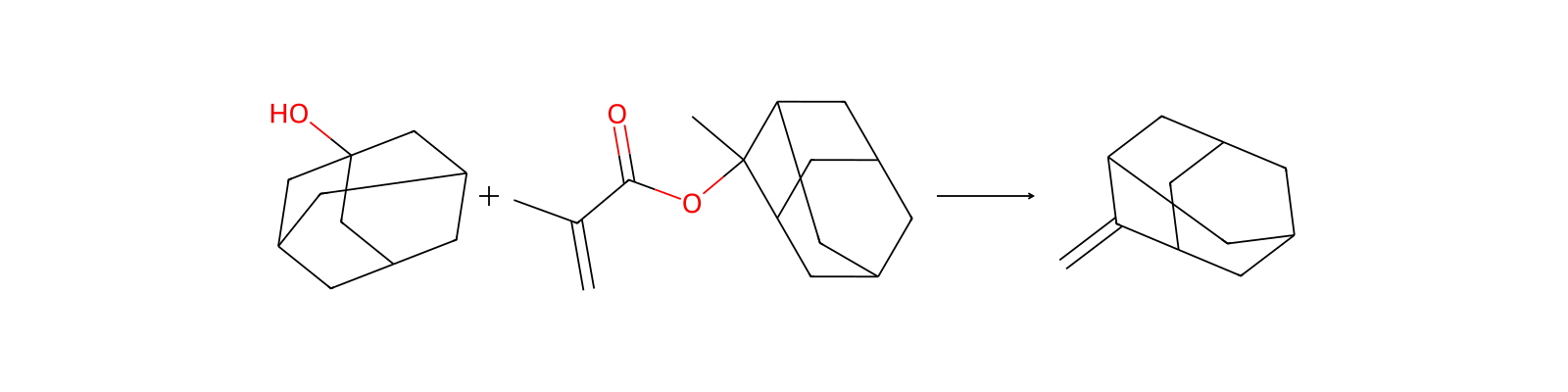

Basic information
- CAS
177080-67-0- Standard SMILES
C=C(C)C(=O)OC1(C)C2CC3CC(C2)CC1C3- InChIKey
FDYDISGSYGFRJM-UHFFFAOYSA-N- Molecular formula
- C15H22O2
- Average molar mass
- 234.33 g/mol
- Monoisotopic mass
- 234.16197994
Names & identifiers
- Preferred name
- 2-Methyl-2-adamantyl methacrylate
- IUPAC
- (2-methyl-2-adamantyl) 2-methylprop-2-enoate
- English name
- 2-Methacryloyloxy-2-methyladamantane
- Molecular formula
- C15H22O2
- Molecular weight
- 234.33
Names & synonyms
177080-67-02-METHYL-2-ADAMANTYL METHACRYLATE2-Methacryloyloxy-2-methyladamantaneDTXSID00431592RefChem:475152DTXCID90382423805-868-12-Methyladamantan-2-yl methacrylate2-Methyl-2-adamantylmethacrylate(2-methyl-2-adamantyl) 2-methylprop-2-enoate2-Methyl-acrylic acid 2-methyl-adamantan-2-yl ester2-METHYLADAMANTAN-2-YL 2-METHYLPROP-2-ENOATE
Show more names
MADMA MAMA2-METHYL-2-ADAMANTYL METHACRYL-Methyl-2-adamantylmethacrylate2-Ethy1-2-adamantylmethacrylate2-Methyl-2-adaMantyl Methacrylte2-Methyl-2-adamantanyl methacrylate2-Methyl-2-adamantyl methacrylate (MADMA)
MFCD041143542-methacryloyloxy-2-methyladamantane (stabilized with mehq)2-Propenoic acid, 2-methyl-, 2-methyltricyclo[3.3.1.13,7]dec-2-yl ester2-Methacryloyloxy-2-methyladamantane(stabilizedwithMEHQ)Methacrylic Acid 2-Methyl-2-adamantyl EsterSCHEMBL44331SCHEMBL19587032-Methyladamantan-2-ylmethacrylate
Database identifiers
Properties
Computed structural properties
- XLogP
- 3.7
- Topological polar surface area
- 26.3 Ų
- Hydrogen bond donors
- 0
- Hydrogen bond acceptors
- 2
- Rotatable bonds
- 3
- Heavy atoms
- 17
- Formal charge
- 0
- Complexity
- 341
Physicochemical properties
- Boiling point
- 301.3 · 301.3±11.0 °C(Predicted)
- Density
- 1.06 · 1.06±0.1 g/cm3(Predicted)
- refractive index
- 1.505 to · 1.5050 to 1.5090
- Flash point
- 120 °C · 120°C(lit.)
- storage temp.
- 2 · 2-8°C
- form
- clear liquid
- color
- Colorless to Almost colorless
- Specific Gravity
- 1.06 · 1.06
- Sensitive
- Heat Sensitive
- InChI
- InChI=1S/C15H22O2/c1-9(2)14(16)17-15(3)12-5-10-4-11(7-12)8-13(15)6-10/h10-13H,1,4-8H2,2-3H3
- InChIKey
- FDYDISGSYGFRJM-UHFFFAOYSA-N
- SMILES
- C(OC1(C)C2CC3CC1CC(C3)C2)(=O)C(C)=C
- Symbol(GHS)
- 7 · GHS07
- Signal word
- Warning
- Hazard statements
- 315 · H315-H319
- Precautionary statements
Safety & regulation
GHS classification
GHS Classification
Warning
H315 (100%): Causes skin irritation [Warning Skin corrosion/irritation]
P264, P264+P265, P280, P302+P352, P305+P351+P338, P321, P332+P317, P337+P317, and P362+P364 (click each P-code to see the statement)
The GHS information provided by 1 company from 1 notification to the ECHA C&L Inventory.
Hazard information
Hazard Classes and CategoriesSkin Irrit. 2 (100%)
Safety data
- hs_code
- 2902190000
- Signal word
- Warning
- Symbol(GHS)
- GHS07
- Hazard statements
- H315-H319
- Precautionary statements
- P305+P351+P338
Chemistry & industry
Applications
Description2-Methyl-2-adamantylmethacrylate (2-Methacryloyloxy-2-methyladamantane) is an aliphatic hydrocarbon with a trifluoromethyl group. It is a monomer that can be used to make polymers. 2-Methyl-2-adamantylmethacrylate has been shown to polymerize rapidly and form high molecular weight polymers. It reacts with hydroxyl groups to form ester linkages. This molecule also has the ability to self assemble, making it a supramolecular material. Impurities may affect the polymerization kinetics of this molecule and must be removed before use. As this compound is hydrophobic, it can only be patterned using a sublimable process.
Uses2-Methyl-2-adamantylmethacrylate can be used to prepare Analog Semiconductors, Light-Emitting Diodes LED, Solar Photovoltaics PV.
General DescriptionThree different methacrylic monomers (g-butyrolactone methacrylate (GBLMA), 3-hydroxyl-1-adamantyl methacrylate (HAMA), and 2-methyl-2- adamantyl methacrylate (MAMA)) are the most often terpolymerized for 193 nm photoresists. The lactone group of GBLMA plays a vital role in the etching rate, facilitating binding to the substrate. The hydroxyl group of HAMA aids in the solubility and stability of the polymer. MAMA is particularly sensitive to 193 nm light and improves the etching resolution (chemical amplification)[1].
Upstream & downstream products
Upstream raw materials
Suppliers100 total
梯希爱(上海)化成工业发展有限公司021-67121386 · [email protected]
湖北永阔科技有限公司027-59223108 15972152991 · [email protected]
上海凌富药物研究有限公司+86(21)5895 0110 19945755304 · [email protected]
Related reactions
24 records


Compound notes
Loading…