HomeMCPWorkbenchSkills
HomeWorkbenchNotificationsMe
llms.txt · MCP GuidePrivacy Policy · Terms of Service · Supportv1.8.0
  1. Home
  2. /Compound

Trifluoroacetic anhydride

HCID 9845
New noteNew reactionRequest quotes
Print preview

Completing data — refresh the page later to see the latest

Basic informationNames & identifiersPropertiesSafety & regulationChemistry & industryRelated reactionsCompound notes
Substructure searchFind similar structures

Basic information

CAS
407-25-0
Standard SMILES
O=C(OC(=O)C(F)(F)F)C(F)(F)F
InChIKey
QAEDZJGFFMLHHQ-UHFFFAOYSA-N
Molecular formula
C4F6O3
Average molar mass
210.03 g/mol
Monoisotopic mass
209.97516318

Names & identifiers

Preferred name
Trifluoroacetic anhydride
IUPAC
(2,2,2-trifluoroacetyl) 2,2,2-trifluoroacetate
English name
Trifluoroacetic anhydride
Molecular formula
C4F6O3
Molecular weight
210.03

Names & synonyms

TRIFLUOROACETIC ANHYDRIDE407-25-0Trifluoroacetic acid anhydrideBis(trifluoroacetic) anhydridePerfluoroacetic anhydrideTrifluoroacetyl anhydrideHexafluoroacetic anhydrideAnhydrid kyseliny trifluoroctove5ENA87IZHTNSC-96965DTXSID90861920RefChem:899576
Show more names
trifluoroaceticTRIFLUORACETIC ANHYDRIDETIFLUOROACETIC ANHYDRIDETrifluoroacetic anhyTrifluoroacetic anhydride 10g [407-25-0]uoroacetic anhydridetrimethylamine (TMA)
DTXCID90810771206-982-9TFAA2,2,2-trifluoroacetic anhydrideAcetic acid, trifluoro-, anhydridetrifluoro acetic anhydride(2,2,2-trifluoroacetyl) 2,2,2-trifluoroacetate2,2,2-trifluoroacetyl 2,2,2-trifluoroacetate

Database identifiers

CAS
407-25-0
PubChem CID
9845
DTXSID
DTXSID90861920
UNII
5ENA87IZHT
EC Number
206-982-9
Nikkaji
J5.723A

Properties

Computed structural propertiesFilling in

XLogP
2.1
Topological polar surface area
43.4 Ų
Hydrogen bond donors
0
Hydrogen bond acceptors
9
Rotatable bonds
2
Heavy atoms
13
Formal charge
0
Complexity
201

Experimental & physicochemical properties

Chemical ClassesOther Classes -> Acid Anhydrides, Other
PFAS · 2 items

PFAS -> PFAS identified in REACH Regulation EC No. 1272/2008

PFAS -> Suspected persistent, mobile, toxic (PMT) PFAS or PFAS-like compounds

SpringerMaterials PropertiesSchoenflies notation
Density1.49 @25 °C
Boiling Point39.5 °C @760 [mm Hg]
Vapor Pressure41.2 [mmHg]
Physical Description · 2 items

Liquid

Colorless liquid; [MSDSonline]

Physicochemical properties

Melting point
-65 °C · -65 °C (lit.)
Boiling point
39.5 · 39.5-40 °C (lit.)

Safety & regulation

Safety information is for reference only and does not replace the supplier’s Safety Data Sheet (SDS), applicable regulations, or professional assessment.

GHS classification

GHS Classification · 4 items

Danger

H314 (100%): Causes severe skin burns and eye damage [Danger Skin corrosion/irritation]

P203, P260, P261, P264, P264+P265, P271, P273, P280, P301+P330+P331, P302+P361+P354, P304+P340, P305+P354+P338, P316, P317, P318, P321, P363, P405, and P501 (click each P-code to see the statement)

Aggregated GHS information provided per 114 reports by companies from 21 notifications to the ECHA C&L Inventory. Each notification may be associated with multiple companies.

Hazard information

Regulatory Information · 4 items

Chemical: Acetic acid, trifluoro-, anhydride

Acetic acid, 2,2,2-trifluoro-, 1,1'-anhydride is listed on the EPA's Chemical Data Reporting (CDR) system. Manufacturers and importers of Acetic acid, 2,2,2-trifluoro-, 1,1'-anhydride are required to report information about their production and use of this chemical to the EPA under the Toxic Substances Control Act (TSCA). (40 eCFR Part 711)

Status: Active Update: 29-04-2019 https://echa.europa.eu/registration-dossier/-/registered-dossier/10848

Trifluoroacetic anhydride: HSNO Approval: HSR004742 Approved with controls

Hazards SummaryCorrosive to skin; [eChemPortal: ERMA] Reacts with water; A corrosive substance that can cause injury to the skin, eyes, and respiratory tract; Inhalation may cause chemical pneumonitis; [MSDSonline]
Hazard Classes and CategoriesSkin Corr. 1A (100%)

Safety & protection

Protective Action Criteria (PAC) · 3 items

0.60 [mg/m3]

6.6 [mg/m3]

Chemistry & industry

Uses & manufacturing

U.S. Production2023: <50,000 lb
Industry UsesIntermediate
General Manufacturing Information · 2 items

Miscellaneous Manufacturing

Acetic acid, 2,2,2-trifluoro-, 1,1'-anhydride: ACTIVE

Applications · 3 items

DescriptionTrifluoroacetic acid anhydride (TFAA), a perfluoroacylated acylation reagent, forms stable, volatile derivatives with alcohols, amines, and phenols.

UsesUsed as analytical reagents, solvents, catalysts, dehydration condensing agent, protection agent of trifluoroacetylation of carboxyl and amino; used as Intermediate of fluorine fine chemicals, pharmaceutical, agrochemical.

UsesTrifluoroacetic anhydride is used for the introduction of trifluoroacetyl group in organic synthesis. It is involved in the preparation of N- and O-trifluoroacetyl derivatives of a wide range of biologically active compounds for gas chromatography analysis. It plays an important role as desiccant for trifluoroacetic acid. It is also used in the oxidation of aldehydes to acids, esters, amides as well as in the protection of alcohols and amines. In addition, it is used as analytical reagents, solvents and dehydration condensing agent. It serves as an intermediate of fluorine fine chemicals, pharmaceuticals and agrochemicals.

Preparation methods

PreparationTrifluoroacetic anhydride is prepared by reaction of trifluoroacetyl chloride with an alkali metal or alkaline-earth metal salt of trifluoroacetic acid at approximately 50° C.

Upstream & downstream products

Upstream raw materials

Dichloroacetic anhydride

Related reactions

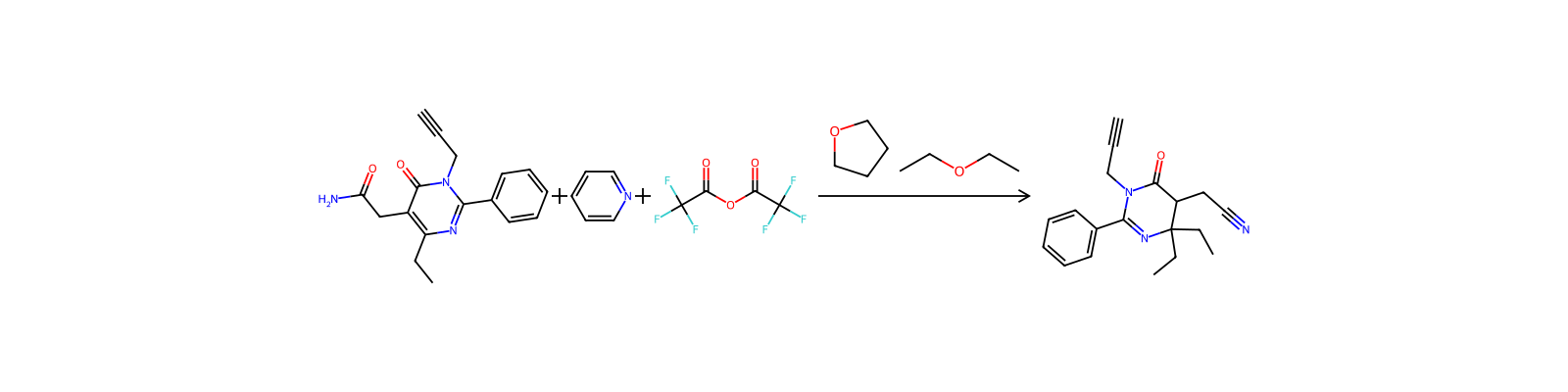
2,516 records
New reaction record
HRID 1463 reaction equation
HRID 1463As reactantuspto-grants-1998_03
HRID 2295 reaction equation
HRID 2295As solventuspto-grants-1998_03
HRID 3676 reaction equation
HRID 3676As reactantuspto-grants-1998_03
HRID 3680 reaction equation
HRID 3680As reactantuspto-grants-1998_03
HRID 5039 reaction equation
HRID 5039As reactantuspto-grants-1993_09
HRID 5043 reaction equation
HRID 5043As reactantuspto-grants-1993_09
HRID 6363 reaction equation
HRID 6363As reactantuspto-grants-1993_09
HRID 8266 reaction equation
HRID 8266As reactantuspto-grants-2006_08
Page 1 of 315

Compound notes

Loading…

On this pageBasic informationNames & identifiersPropertiesSafety & regulationChemistry & industryRelated reactionsCompound notes
More actions
New noteNew reactionRequest quotes
Density
1.511 g/mL · 1.511 g/mL at 20 °C (lit.)
vapor pressure
6.28 psi · 6.28 psi ( 20 °C)
refractive index
20 · n20/D 1.3(lit.)
Flash point
-26 °C · -26 °C
storage temp.
2 · 2-8°C
solubility
Miscible with benzene, dichloromethane, diethyl ether, dimethylformamide, terahydrofuran and acetonitrile.
form
Liquid
pka
0.43 · 0.43[at 20 ℃]
Specific Gravity
1.487 · 1.487
color
Clear
Water Solubility
Hydrolysis
Sensitive
Moisture Sensitive
BRN
746197 · 746197
Stability
Stable, but moisture sensitive. Reacts with water to liberate hydrogen (flammable!). Incompatible with water, strong oxidizing agents.
InChI
1S/C4F6O3/c5-3(6,7)1(11)13-2(12)4(8,9)10
InChIKey
QAEDZJGFFMLHHQ-UHFFFAOYSA-N
SMILES
FC(F)(F)C(=O)OC(=O)C(F)(F)F
LogP
0.79 at · 0.79 at 25℃
CAS DataBase Reference
407 · 407-25-0(CAS DataBase Reference)
FDA UNII
5 ENA87IZHT · 5ENA87IZHT
NIST Chemistry Reference
Acetic acid, trifluoro-, anhydride(407-25-0)
EPA Substance Registry System
Acetic acid, trifluoro-, anhydride (407-25-0)
UNSPSC Code
12352106 · 12352106
NACRES
22 · NA.22
Symbol(GHS)
5 · GHS05,GHS07
Signal word
Danger
Hazard statements
302 · H302+H312+H332-H314-H412-H290
Precautionary statements
501 · P501-P261-P273-P270-P234-P271-P264-P280-P390-P362+P364-P303+P361+P353-P301+P330+P331-P301+P312+P330-P304+P340+P310-P305+P351+P338+P310-P406-P405
PPE
Faceshields, Gloves, Goggles
Hazard Codes
C,T
Risk Statements
14 · 14-20-35-52/53-34-23/24/25
Safety Statements
26 · 26-36/37/39-43-45-61-9-8-28A-27
RIDADR
3265 · UN 3265 8/PG 1
WGK Germany
2 · 2
RTECS
9800000 · AJ9800000
F
3 · 3-10
Hazard Note
Corrosive/Moisture Sensitive
TSCA
TSCA listed
HazardClass
8 · 8
PackingGroup
I
HS Code
29159080 · 29159080
Storage Class
8 B · 8B - Non-combustible corrosive hazardous materials
Hazard Classifications
4 InhalationAquatic · Acute Tox. 4 InhalationAquatic Chronic 3Eye Dam. 1Skin Corr. 1A
Toxicity
500 mg/24H · skn-rbt 500 mg/24H SEV 28ZPAK -,91,72
REACH Registrations
Active
Excepted Quantities
Not Permitted as Excepted Quantity

40 [mg/m3]

Toxicology

Adverse EffectsDermatotoxin - Skin burns.

Safety data

F
3-10
PPE
Faceshields, Gloves, Goggles
wgk
2
tsca
TSCA listed
rtecs
AJ9800000
ridadr
UN 3265 8/PG 1
hs_code
29159080
Toxicity
skn-rbt 500 mg/24H SEV 28ZPAK -,91,72
risk_code
14-20-35-52/53-34-23/24/25
Signal word
Danger
Symbol(GHS)
GHS05,GHS07
hazard_code
C,T
hazard_note
Corrosive/Moisture Sensitive
safety_code
26-36/37/39-43-45-61-9-8-28A-27
hazard_class
8
Storage Class
8B - Non-combustible corrosive hazardous materials
packing_group
I
Hazard statements
H302+H312+H332-H314-H412-H290
Excepted Quantities
Not Permitted as Excepted Quantity
REACH Registrations
Active
Hazard Classifications
Acute Tox. 4 InhalationAquatic Chronic 3Eye Dam. 1Skin Corr. 1A
Precautionary statements
P501-P261-P273-P270-P234-P271-P264-P280-P390-P362+P364-P303+P361+P353-P301+P330+P331-P301+P312+P330-P304+P340+P310-P305+P351+P338+P310-P406-P405
Trifluoroacetic acid

Downstream products

1-[4-(Trifluoromethyl)pyrimid-2-yl]piperazine2-Cyano-4-pyridine carboxylic acid2-Hydroxy-4-(trifluoromethyl)pyrimidine5-Bromo-2-hydroxymethylpyridine2-(4-Methylpiperazin-1-yl)-6-(trifluoromethyl)pyrimidine-4-carbonitrile2-Chloro-4-(trifluoromethyl)pyrimidine[Bis(trifluoroacetoxy)iodo]pentafluorobenzene6-Aminobenzothiazole2-Hydroxy-6-(trifluoromethyl)nicotinic acid2-(4-Methylpiperazin-1-yl)-6-(trifluoromethyl)pyrimidine-4-carboxamide(2-(4-Methylpiperazin-1-yl)-6-(trifluoromethyl)pyrimidin-4-yl)methanamine2,6-Dichloro-4-isocyanatopyridineEthyl 2-(4-hydroxypiperidin-1-yl)-6-(trifluoromethyl)pyrimidine-4-carboxylateEthyl 2-(4-(ethoxycarbonyl)piperidin-1-yl)-6-(trifluoromethyl)pyrimidine-4-carboxylateEthyl 2-(4-(hydroxymethyl)piperidin-1-yl)-6-(trifluoromethyl)pyrimidine-4-carboxylate3-(Trifluoromethyl)pyrazole1-Methyl-3-(trifluoromethyl)-1H-pyrazoleChlorfenapyr(2-(4-Methylpiperazin-1-yl)-6-(trifluoromethyl)pyrimidin-4-yl)methanol3-(Trifluoromethyl)-1,2,4-triazolo[4,3-a]pyrazine4-Chloro-alpha-[methyl(trifluoroacetyl)amino]-benzeneacetic acid2-(Methylthio)-4-(trifluoromethyl)pyrimidinetert-Butyl 4-[4-(trifluoromethyl)pyrimidin-2-yl]piperazine-1-carboxylate ,97%3-Nitroisonicotinic acidEthyl 2-(4-methylpiperazin-1-yl)-6-(trifluoromethyl)pyrimidine-4-carboxylate3-(Trifluoromethyl)-5,6,7,8-tetrahydro-[1,2,4]triazolo[4,3-a]pyrazine5-Iodo-2,4-dimethoxypyrimidineN10-(Trifluoroacetyl)pteroic acid3-Amino-4-nitrobenzitrifluoride2-(Trifluoroacetyl)thiophene2-Bromo-4-(trifluoromethyl)pyrimidine2-(4-Methylpiperazin-1-yl)-6-(trifluoromethyl)pyrimidine-4-carbaldehydeEpirubicin2-(Bromomethyl)-6-methylpyridine5-Bromopyridine-2-carbaldehydeEthyl 5-amino-3-(trifluoromethyl)-1H-pyrazole-4-carboxylate2-(4-Methylpiperazin-1-yl)-6-(trifluoromethyl)pyrimidine-4-carboxylic acid2-(4-Methylpiperazin-1-yl)-6-(trifluoromethyl)pyrimidin-4-amine3-Chloro-5-nitropyridine[Bis(trifluoroacetoxy)iodo]benzene