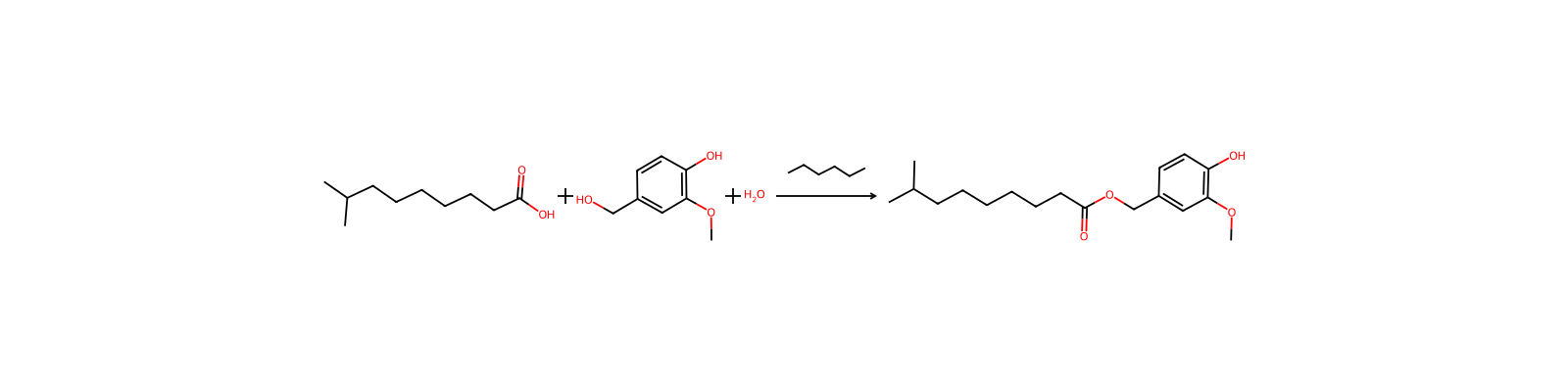

Basic information
- CAS
205687-03-2- Standard SMILES
COc1cc(COC(=O)CCCCCCC(C)C)ccc1O- InChIKey
RBCYRZPENADQGZ-UHFFFAOYSA-N- Molecular formula
- C18H28O4
- Average molar mass
- 308.4 g/mol
- Monoisotopic mass
- 308.19875938
Overview
Dihydrocapsiate is a member of phenols and a member of methoxybenzenes.
Names & identifiers
- Preferred name
- Dihydrocapsiate
- IUPAC
- (4-hydroxy-3-methoxyphenyl)methyl 8-methylnonanoate
- English name
- 8-Methylnonanoic acid (4-hydroxy-3-methoxyphenyl)methyl ester
- Molecular formula
- C18H28O4
- Molecular weight
- 308.41
Names & synonyms
dihydrocapsiate205687-03-2(4-HYDROXY-3-METHOXYPHENYL)METHYL 8-METHYLNONANOATENonanoic acid, 8-methyl-, (4-hydroxy-3-methoxyphenyl)methyl esterW2F7769AEUDTXSID80174576RefChem:133747DTXCID2097067859-192-74-Hydroxy-3-methoxybenzyl 8-methylnonanoateMFCD29917840UNII-W2F7769AEU
Show more names
Dihydrocapsiate【5088】8-Methylnonanoic acid (4-hydroxy-3-methoxyphenyl)methyl este8-Methylnonanoic acid (4-hydroxy-3-methoxyphenyl)methyl esterNonanoic acid,8-methyl-, (4-hydroxy-3-methoxyphenyl)methyl ester
CCRIS 9424Vanillyl 8-methylnonanoateDihydrocapsiate (Standard)(4-hydroxy-3-methoxy-phenyl)methyl 8-methylnonanoateorb1689288SCHEMBL1585862CHEBI:174951RBCYRZPENADQGZ-UHFFFAOYSA-N
Database identifiers
- CAS
205687-03-2- PubChem CID
- 9873754
- DTXSID
DTXSID80174576- ChEBI
CHEBI:174951- UNII
- W2F7769AEU
- EC Number
- 859-192-7
- Nikkaji
- J969.321A
Properties
Computed structural properties
- XLogP
- 5
- Topological polar surface area
- 55.8 Ų
- Hydrogen bond donors
- 1
- Hydrogen bond acceptors
- 4
- Rotatable bonds
- 11
- Heavy atoms
- 22
- Formal charge
- 0
- Complexity
- 303
Physicochemical properties
- Boiling point
- 413.6 · 413.6±30.0 °C(Predicted)
- Density
- 1.038 · 1.038
- storage temp.
- -20 °C, · Store at -20°C, protect from light
- pka
- 9.51 · 9.51±0.20(Predicted)
- form
- Liquid
- color
- Colorless to light yellow
- Major Application
- cleaning productscosmeticsflavors and fragrancesfood and beveragespersonal care
- InChI
- 1S/C18H28O4/c1-14(2)8-6-4-5-7-9-18(20)22-13-15-10-11-16(19)17(12-15)21-3/h10-12,14,19H,4-9,13H2,1-3H3
- InChIKey
- RBCYRZPENADQGZ-UHFFFAOYSA-N
- SMILES
- OC1=C(OC)C=C(COC(CCCCCCC(C)C)=O)C=C1
- LogP
- 5.094 · 5.094 (est)
- FDA UNII
- 2 F7769AEU · W2F7769AEU
- UNSPSC Code
- 41116107 · 41116107
- NACRES
- 24 · NA.24
- Symbol(GHS)
- 6 · GHS06
- Signal word
- Danger
- Hazard statements
- 300 · H300-H315-H319-H335
- Precautionary statements
- 501 · P501-P261-P270-P271-P264-P280-P302+P352-P337+P313-P305+P351+P338-P362+P364-P332+P313-P301+P310+P330-P304+P340+P312-P403+P233-P405
- WGK Germany
- 3 · WGK 3
- Storage Class
- 10 · 10 - Combustible liquids
- Hazard Classifications
- 4 · Aquatic Chronic 4
Safety & regulation
GHS classification
GHS Classification
This chemical does not meet GHS hazard criteria for 50% (1 of 2) of reports.
H413 (50%): May cause long lasting harmful effects to aquatic life [Hazardous to the aquatic environment, long-term hazard]
P273, and P501 (click each P-code to see the statement)
Aggregated GHS information provided per 2 reports by companies from 2 notifications to the ECHA C&L Inventory.
Hazard information
Regulatory InformationRegulation (EC) No 258/1997
Hazard Classes and CategoriesAquatic Chronic 4 (50%)
Safety data
- wgk
- WGK 3
- Signal word
- Danger
- Symbol(GHS)
- GHS06
- Storage Class
- 10 - Combustible liquids
- Hazard statements
- H300-H315-H319-H335
- Hazard Classifications
- Aquatic Chronic 4
- Precautionary statements
- P501-P261-P270-P271-P264-P280-P302+P352-P337+P313-P305+P351+P338-P362+P364-P332+P313-P301+P310+P330-P304+P340+P312-P403+P233-P405
Chemistry & industry
Pharmacology
Cellular LocationsMembrane
Applications
UsesDihydrocapsiate, is a complex that is found in chili peppers which has been used in different biological studies to determine the inhibitory effects. This includes the studies performed on cytochrome P 450 3A4 in human liver microsomes.
Suppliers43 total
南京世洲生物科技有限公司025-85560043 15850508050 · [email protected]
成都普瑞法科技开发有限公司+86-028-82633397 18982077548 · [email protected]
南通飞宇生物科技有限公司0513-68819626 15152877458 · [email protected]
銘瑞集團有限公司17318633522 · [email protected]
成都超九八生物科技有限公司13348960310 13348960310 · [email protected]
河南赢创生物科技有限公司16650615803 · [email protected]
咸宁深蓝生物医药研发有限公司18171815831 · [email protected]
上海毕得医药科技股份有限公司400-1647117 13681763483 · [email protected]
VladaChem GmbH+49-7246-3082843 +86-18411632868 · [email protected]
成都普睿法药物研发有限公司82633860 18982077548 · [email protected]
Dayang Chem (Hangzhou) Co.,Ltd.+86-0571-88938639 17705817739 · [email protected]
浙江珲达生物科技有限公司0571-89903022 18679456698 · [email protected]
Aladdin Scientific[email protected]
安耐吉化学&3A(安徽泽升科技有限公司)021-58432009 400-005-6266 · [email protected]
成都普思生物科技股份有限公司028-85370565-229 18080489829 · [email protected]
杭州杰恒化工有限公司0571-87396432 · [email protected]
上海永叶生物科技有限公司86-021-61559134 15921386130 · [email protected]
四川精萃天成药物科技有限公司028-87865381 18108190480 · [email protected]
上海萄普生物医药技术有限公司15900573766 18018507602 · [email protected]
HANGZHOU LEAP CHEM CO., LTD.+86-571-87711850 +86-15355479329 · [email protected]
上海一飞生物科技有限公司021-65675885 18964387627 · [email protected]
上海源叶生物科技有限公司13636370518 · [email protected]
上海澄绍生物科技有限公司021-61847300 13341622919 · [email protected]
上海依赫生物科技有限公司021-68882955 17721395025 · [email protected]
Mensura Group Limited18780014153 · [email protected]
Shanghai Acmec Biochemical Technology Co., Ltd.+86-18621343501 · [email protected]
杭州洁汉化工有限公司+86-571-86217390; +8618058761490 · [email protected]
上海臻励生物科技有限公司021-16621358918; 18516310516;16621358918;13045646768 · [email protected]
江苏艾康生物医药研发有限公司025-66061636 19370895928 · [email protected]
career henan chemical co+86-0371-86658258 · [email protected]
湖北康鑫源顺医药化工有限公司027-51831887 15337167856 · [email protected]
湖南旭康医药科技有限公司18569072650 · [email protected]
成都普瑞法科技开发有限公司+86-28-82633860; +86-18080483897 · [email protected]
浙江联硕生物科技有限公司18616526224 · [email protected]
四川恒诚致远生物科技有限公司028-82632533 18113192475 · [email protected]
SHANGHAI KEAN TECHNOLOGY CO., LTD.+8613817748580 · [email protected]
上海莫奇生物科技有限公司13341702378 · [email protected]
陕西缔都医药有限责任公司81148925 17391631969 · [email protected]
湖北萃园生物科技有限公司18162795156 18162795156 · [email protected]
上海杰股生物科技有限公司021-51698675 · [email protected]
TargetMol中国(陶术生物)15002134094 · [email protected]
上海陶术生物科技股份有限公司+1-781-999-5354 · [email protected]
上海抚生实业有限公司021-52961053 13524666654 · [email protected]
Additional notes
DefinitionChEBI: Dihydrocapsiate is a member of methoxybenzenes and a member of phenols.
Related reactions
10 records


Compound notes
Loading…