

Basic information
- Standard SMILES
O=C(Cl)C12CC3CC(CC(C3)C1)C2- InChIKey
MIBQYWIOHFTKHD-UHFFFAOYSA-N- Molecular formula
- C11H15ClO
- Average molar mass
- 198.69 g/mol
- Monoisotopic mass
- 198.08114278
Overview
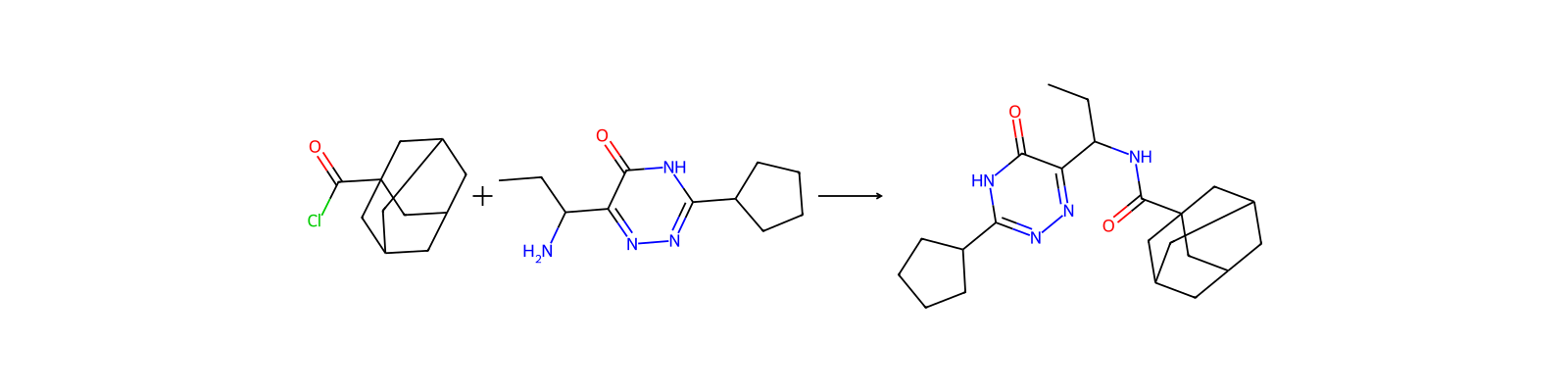
structure in first source
Names & identifiers
- Preferred name
- 1-Adamantanecarbonyl chloride
- IUPAC
- adamantane-1-carbonyl chloride
- English name
- 1-Adamantanecarbonyl chloride
- Molecular formula
- C11H15ClO
- Molecular weight
- 198.69
Names & synonyms
1-Adamantanecarbonyl chloride2094-72-6Tricyclo(3.3.1.1'3,7)decane-1-carbonyl chlorideDTXSID20175108RefChem:899307DTXCID9097599218-252-7Adamantane-1-carbonyl chlorideAdamantanecarbonyl chloride1-Adamantoyl chlorideAdamantoyl chloride1-Adamantanecarboxylic acid chloride
Show more names
SKL1298Saxaint-LAKOS BC-0659Adamantane-1-carbonyLAdamantyl chloroformategoldalkane-1-formylchloro
1-Adamantanoic acid chlorideMFCD00074724Adamantane-1-carboxylic acid chloride1-Adamantylcarbonyl chloride1-Adamantyl carbonyl chlorideTricyclo[3.3.1.13,7]decane-1-carbonyl chloride1-ADAMANTANE CARBONYL CHLORIDENSC249324
Database identifiers
- CAS
2094-72-6- PubChem CID
- 98915
- DTXSID
DTXSID20175108- EC Number
- 218-252-7
- Nikkaji
- J150.553J
Properties
Computed structural properties
- XLogP
- 3.6
- Topological polar surface area
- 17.1 Ų
- Hydrogen bond donors
- 0
- Hydrogen bond acceptors
- 1
- Rotatable bonds
- 1
- Heavy atoms
- 13
- Formal charge
- 0
- Complexity
- 218
Experimental & physicochemical properties
SpringerMaterials PropertiesNuclear quadrupole resonance spectroscopy
Physicochemical properties
- Melting point
- 49 · 49-51 °C(lit.)
- Boiling point
- 135 · 135-136 °C10 mm Hg(lit.)
- Density
- 1.049 · 1.0490 (rough estimate)
- refractive index
- 1.5364 · 1.5364 (estimate)
- Flash point
- 230 °F · >230 °F
- storage temp.
- 2 · Inert atmosphere,2-8°C
- solubility
- soluble in Toluene
- form
- Crystalline Solid
- color
- White to almost white
- Water Solubility
- may decompose
- Sensitive
- Moisture Sensitive
- BRN
- 389960 · 389960
- InChI
- 1S/C11H15ClO/c12-10(13)11-4-7-1-8(5-11)3-9(2-7)6-11/h7-9H,1-6H2/t7-,8+,9-,11-
- InChIKey
- MIBQYWIOHFTKHD-KJZNFTALSA-N
- SMILES
- ClC(=O)C12C[C@H]3C[C@H](C[C@H](C3)C1)C2
- CAS DataBase Reference
- 2094 · 2094-72-6(CAS DataBase Reference)
- NIST Chemistry Reference
- 1 · 1-Adamantanecarboxlic acid chloride(2094-72-6)
- UNSPSC Code
- 12352100 · 12352100
- NACRES
- 22 · NA.22
- Symbol(GHS)
- 5 · GHS05
- Signal word
- Danger
- Hazard statements
- 314 · H314
- Precautionary statements
- 260 · P260-P280-P301+P330+P331-P303+P361+P353-P305+P351+P338
- PPE
- 3 · Eyeshields, Faceshields, Gloves, type P3 (EN 143) respirator cartridges
- Hazard Codes
- C
- Risk Statements
- 14 · 14-34-37
- Safety Statements
- 26 · 26-36/37/39-45-24/25
- RIDADR
- 3261 · UN 3261 8/PG 2
- WGK Germany
- 3 · 3
- F
- 10 · 10-21
- HazardClass
- 8 · 8
- PackingGroup
- III
- HS Code
- 29162090 · 29162090
- Storage Class
- 8 A · 8A - Combustible corrosive hazardous materials
- Hazard Classifications
- 1 B · Skin Corr. 1B
- REACH Registrations
- Active
Safety & regulation
GHS classification
GHS Classification
Danger
H314 (100%): Causes severe skin burns and eye damage [Danger Skin corrosion/irritation]
P260, P264, P280, P301+P330+P331, P302+P361+P354, P304+P340, P305+P354+P338, P316, P321, P363, P405, and P501 (click each P-code to see the statement)
Aggregated GHS information provided per 48 reports by companies from 6 notifications to the ECHA C&L Inventory.
Hazard information
Regulatory InformationStatus: Active Update: 25-04-2018 https://echa.europa.eu/registration-dossier/-/registered-dossier/25203
Hazard Classes and CategoriesSkin Corr. 1C (100%)
Safety data
- F
- 10-21
- PPE
- Eyeshields, Faceshields, Gloves, type P3 (EN 143) respirator cartridges
- wgk
- 3
- ridadr
- UN 3261 8/PG 2
- hs_code
- 29162090
- risk_code
- 14-34-37
- Signal word
- Danger
- Symbol(GHS)
- GHS05
- hazard_code
- C
- safety_code
- 26-36/37/39-45-24/25
- hazard_class
- 8
- Storage Class
- 8A - Combustible corrosive hazardous materials
- packing_group
- III
- Hazard statements
- H314
- REACH Registrations
- Active
- Hazard Classifications
- Skin Corr. 1B
- Precautionary statements
- P260-P280-P301+P330+P331-P303+P361+P353-P305+P351+P338
Chemistry & industry
Applications
Uses1-Adamantanecarbonyl chloride was used in the preparation of efficient amine-modified oligodeoxynucleotides for fabrication of DNA microarrays.
General Description1-Adamantanecarbonyl chloride on reaction with triethylammonium isopropylphosphite forms mixed anhydride, an efficient capping reagent for the hydrogen-phosphonate DNA synthesis. It is a good substrate for Friedel–Crafts acylation of anisole in the presence of indium metal.
Upstream & downstream products
Upstream raw materials
Downstream products
Suppliers50 total
国药集团化学试剂有限公司86-21-63210123 · [email protected]
梯希爱(上海)化成工业发展有限公司021-67121386 · [email protected]
郑州阿尔法化工有限公司+86-18530059196 · [email protected]
湖北永阔科技有限公司027-59223108 15972152991 · [email protected]
上海阿拉丁生化科技股份有限公司400-6206333 13167063860 · [email protected]
河北汤武科技有限公司15632360893 · [email protected]
合肥翰刚医药科技有限公司+8618062405514 · [email protected]
INTATRADE GmbH+49 3493/605464 · [email protected]
爱斯特(成都)生物制药股份有限公司+86-28-85122536 85324413 · [email protected]
Baoji Guokang Healthchem co.,ltd+8615604608665 15604608665 · [email protected]
Dayang Chem (Hangzhou) Co.,Ltd.+86-0571-88938639 17705817739 · [email protected]
重庆茂环科技有限公司13996103726 · [email protected]
Syntechem Co.,Ltd[email protected]
上海迈瑞尔生化科技有限公司4006356688 18621169109 · [email protected]
阿法埃莎(中国)化学有限公司400-6106006 · [email protected]
安耐吉化学&3A(安徽泽升科技股份有限公司)400-0056266 · [email protected]
梯希爱(上海)化工贸易有限公司021-61109150 · [email protected]
上海瀚鸿科技股份有限公司021-54306202 13764082696 · [email protected]
上海钰康生物科技有限公司18939844854 · [email protected]
上海钰康生物科技有限公司+86-18930848214 +86-021-56762820 · [email protected]
武汉丰泰威远科技有限公司+86-27-8746-5837 +86-18627785180 · [email protected]
武汉丰泰威远科技有限公司027-87465837 19945049750 · [email protected]
天津希恩思生化科技有限公司400 638 7771 · [email protected]
常州琬瑶生物科技有限公司0519-89185693 15312551983 · [email protected]
重庆怀恩化工有限公司+86-023-62487899 13883934700 · [email protected]
艾科试剂4008-755-333 18080918076 · [email protected]
上海思域化工科技有限公司86-21-34053660 · [email protected]
赛默飞世尔科技(中国)有限公司800-810-5118 · [email protected]
北京伊诺凯科技有限公司400-810-7969 010-59572699 · [email protected]
上海遐瑞医药科技有限公司+86 21 61551611
TCI AMERICA800-4238616 · [email protected]
TOKYO CHEMICAL INDUSTRY CO., LTD.03-36680489 · [email protected]
TCI Europe320-37350700 · [email protected]
无锡中坤生化科技有限公司+86 0510-85629785
北京奥秘佳得医药科技有限公司+86-13522808617 · [email protected]
成都零六生物科技有限公司400-1166-196 13458535857 · [email protected]
雷丁试剂0510-85629785 18013409632 · [email protected]
上海馨远医药科技有限公司021-24206007 13764915196 · [email protected]
上海鑫圭生物科技有限公司15121041756 · [email protected]
上海麦克林生化科技股份有限公司15221275939 15221275939 · [email protected]
阳谷荣科商贸有限公司15863541132 · [email protected]
杭州杰恒化工有限公司0571-87396432 · [email protected]
陕西缔都医药化工有限公司+86-29-87569262 +86-15003564040 · [email protected]
陕西缔都医药化工有限公司029-81024372 17792795018 · [email protected]
湖北巨胜科技有限公司027-59599241 18871490274 · [email protected]
Sigma-Aldrich西格玛奥德里奇(上海)贸易有限公司021-61415566 800-8193336 · [email protected]
九鼎化学(上海)科技有限公司4009209199 · [email protected]
厦门志信化学有限公司+86-5922680277 +86-13806087780 · [email protected]
嘉兴瑞驰生物科技有限公司0573-11111111-1111 18969316891 · [email protected]
成都叮当时代医药科技有限公司028-86040038 · [email protected]
Related reactions
239 records



Linked notes
Loading…