Sodium borohydride → 4-(3-Isopropyl-1H-indol-5-yloxy)-3,5-bis-trifluoromethyl-benzyl alcohol
HRID 1007478
Reaction equation
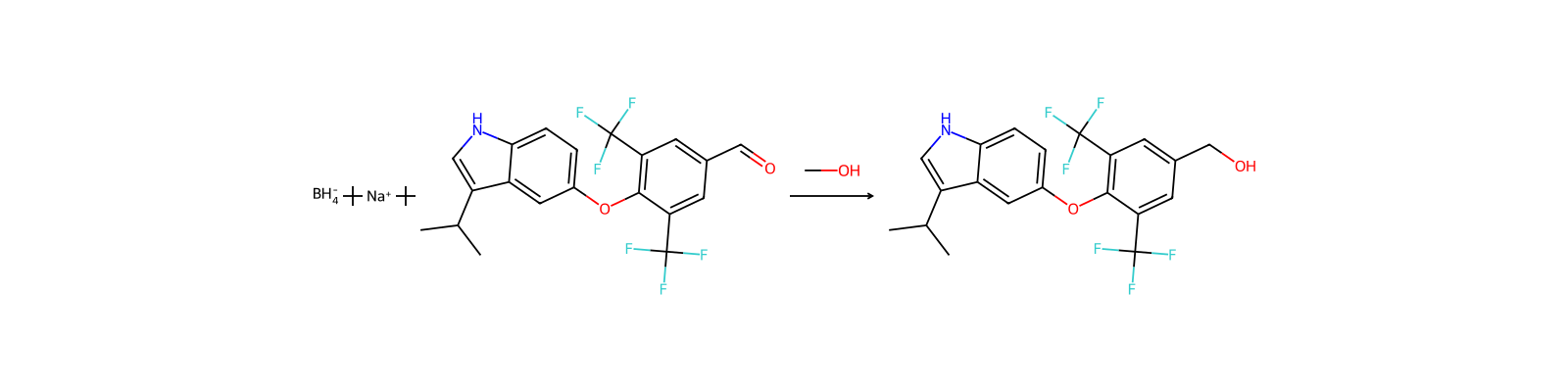
[BH4-].[Na+].[CH:3]([C:6]1[C:14]2[C:9](=[CH:10][CH:11]=[C:12]([O:15][C:16]3[C:23]([C:24]([F:27])([F:26])[F:25])=[CH:22][C:19]([CH:20]=[O:21])=[CH:18][C:17]=3[C:28]([F:31])([F:30])[F:29])[CH:13]=2)[NH:8][CH:7]=1)([CH3:5])[CH3:4]>CO>[CH:3]([C:6]1[C:14]2[C:9](=[CH:10][CH:11]=[C:12]([O:15][C:16]3[C:23]([C:24]([F:25])([F:27])[F:26])=[CH:22][C:19]([CH2:20][OH:21])=[CH:18][C:17]=3[C:28]([F:31])([F:29])[F:30])[CH:13]=2)[NH:8][CH:7]=1)([CH3:5])[CH3:4]Participants
4




Procedure
0.27 g (7.22 mmol) of sodium borohydride is added to a solution of 1.0 g (2.41 mmol) of aldehyde derivative from Example V in 20 ml of methanol in 4 portions at room temperature and the mixture is stirred for 1 hour. Afterwards the reaction solution is concentrated to one half, 60 ml of water are added and the mixture is concentrated until methanol is completely evaporated in a rotary evaporator. The aqueous phase is extracted three times with ethyl acetate, the combined organic phases are washed with sodium chloride solution, dried and concentrated, and the residue is dried in a high vacuum.