Reaction equation
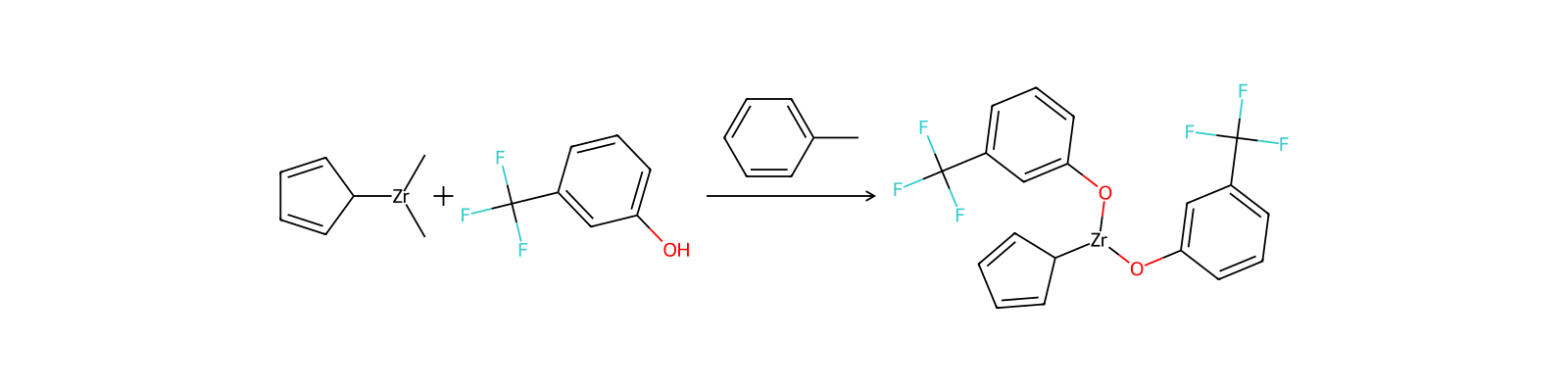
[CH:1]1([Zr:6](C)C)[CH:5]=[CH:4][CH:3]=[CH:2]1.[F:9][C:10]([F:19])([F:18])[C:11]1[CH:16]=[CH:15][CH:14]=[C:13]([OH:17])[CH:12]=1>C1(C)C=CC=CC=1>[CH:1]1([Zr:6]([O:17][C:13]2[CH:14]=[CH:15][CH:16]=[C:11]([C:10]([F:9])([F:18])[F:19])[CH:12]=2)[O:17][C:13]2[CH:14]=[CH:15][CH:16]=[C:11]([C:10]([F:18])([F:19])[F:9])[CH:12]=2)[CH:5]=[CH:4][CH:3]=[CH:2]1Participants
4
Reactant 2

Product 1

Reagents, catalysts & solvents 1

Procedure
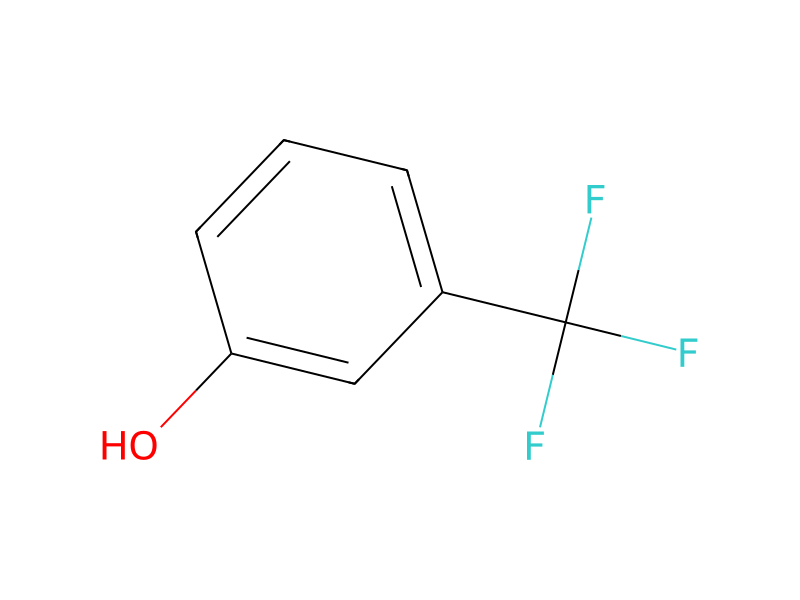
To a 50 ml Schlenk flask containing 138.7 mg (0.5 mmole) of (1-methylboratabenzene) (cyclopentadienyl) dimethyl zirconium [intermediate product of 1st Step] in 15 ml toluene and at 0° C., 162.1 mg (1 mmole) of Trifluoro-m-Cresol in 10 ml toluene is added slowly under stirring. After warming up to room temperature and stirring one hour at room temperature, toluene of the reaction mixture is moved by vacuum. The desired product (1-methylboratabenzene) (cyclopentadienyl) bis(3-trifluoromethylphenoxy) zirconium can be obtained from the residue of vacuum distillation.
Workup
- stirringstirring one hour at room temperature
Sources & evidence
- ORD record
- ord-6cea0494348b410e84f555c127ac38a6
- Source dataset
- uspto-grants-2006_08
- Patent number
- US07094723B2
Linked notes
Loading…