Reaction equation

[CH:1](=[O:5])[CH2:2][CH2:3][CH3:4]>O>[CH2:3]([C:2](=[CH:1][CH2:2][CH2:3][CH3:4])[CH:1]=[O:5])[CH3:4]Participants
Reactant 1
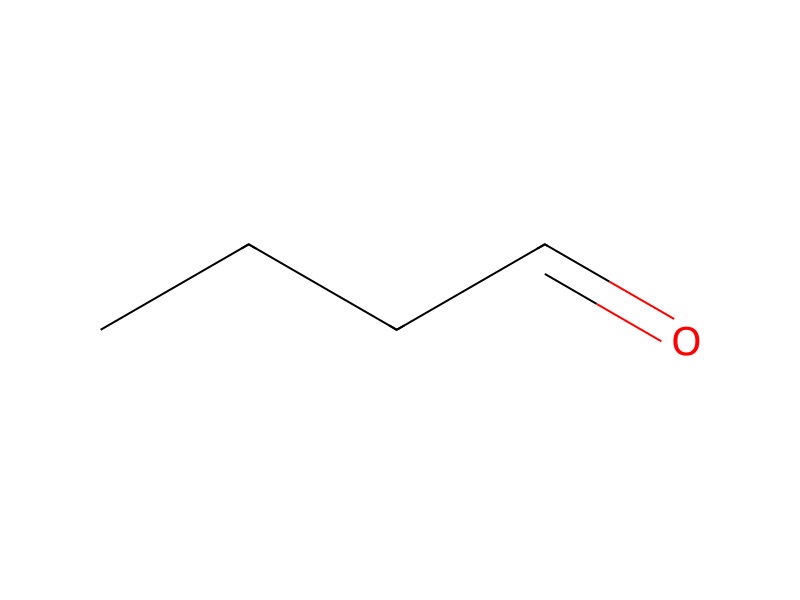
Product 1

Reagents, catalysts & solvents 1

Procedure
The aldol reaction of n-butyraldehyde with simultaneous elimination of water to form 2-ethylhexenal is carried out worldwide on a large scale since the hydrogenation product, viz. 2-ethylhexanol, is used in large quantities as plasticizer alcohol. As catalyst, use is usually made of a base dissolved in water. The use of aqueous sodium hydroxide having an NaOH content in the percentage range is typical. The reaction is frequently carried out in a temperature range of 80-150° C., a pressure of less than 5 bar and a phase ratio of organic phase to aqueous catalyst phase of from 1 to 20 (Hydrocarbon Processing, October 1980, Section 2, pages 93-102). This reaction can, for example, be carried out in a stirred vessel (DE 19 06 850, DE 927 626), in a packed column which is operated in countercurrent (G. Dümbgen, D. Neubauer, Chemie-Ing.-Techn., 41, 974 (1969)), or in a flow tube (GB 761 203). All these processes give 2-ethylhexenal in a selectivity of up to 98% at conversions of 98.5%. A disadvantage is that at relatively high temperatures, part of the n-butyraldehyde used is irreversibly lost as a result of the Cannizzaro reaction. The butyric acid formed in the Cannizzaro reaction neutralizes the basic catalyst. Part of the catalyst solution containing a high burden of organic material therefore has to be continually discharged and replaced by fresh catalyst.
Sources & evidence
- ORD record
- ord-bb73726800a5448ea3131980c01b7d07
- Source dataset
- uspto-grants-2013_10
- Patent number
- US08563782B2
Linked notes
Loading…