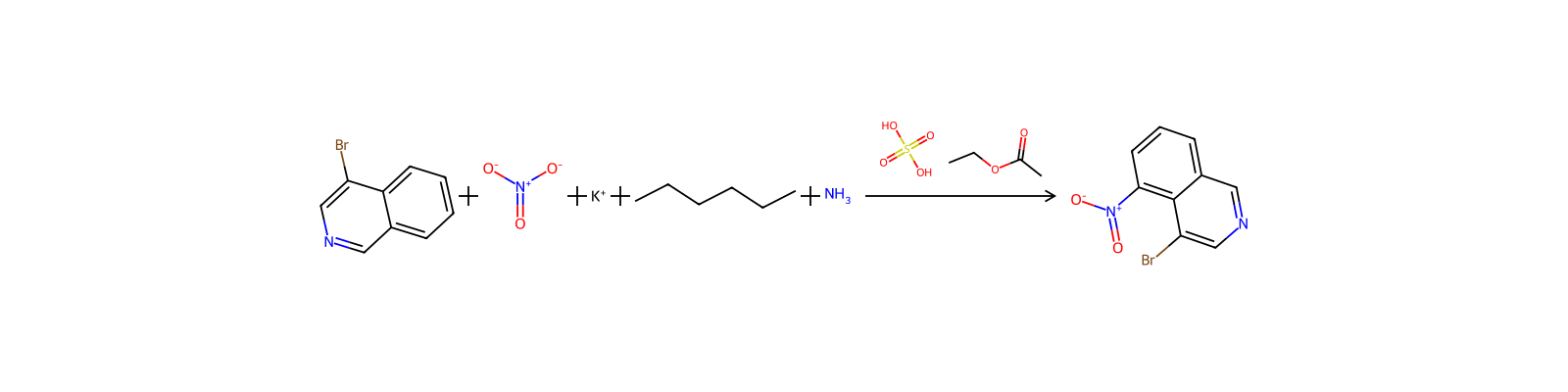
Participants
| Role | Name | HCID | Charge |
|---|
| Reactant | Ammonia | HCID 222 | — |
| Reactant | Hexane | HCID 8058 | — |
| Reactant | Potassium Nitrate | HCID 24434 | — |
| Reactant | 4-Bromoisoquinoline | HCID 73743 | — |
| Solvent | Sulfuric Acid | HCID 1118 | — |
| Solvent | Ethyl Acetate | HCID 8857 | — |
| Product | 4-Bromo-5-nitroisoquinoline | HCID 271280 | 48.5% |
Reaction Steps
With vigorous stirring, concentrated sulfuric acid (36 ml) was added with 4-bromoisoquinoline (10.0 g, Tokyo Kasei Kogyo) to such an extent that the temperature should not exceed 10° C. and stirred for a while to attain complete dissolution. Potassium nitrate (4.9 g, Kanto Chemicals) was dissolved in concentrated sulfuric acid (20 ml), added dropwise to the aforementioned solution at a temperature below −5° C. and further stirred for 2 hours while maintaining that temperature. Disappearance of 4-bromoisoquinoline was confirmed by thin layer chromatography (n-hexane:ethyl acetate=1:1), and then the reaction mixture was slowly poured into cold aqueous ammonia (200 ml, Wako Pure Chemical Industries) with vigorous stirring. The reaction mixture was stirred for 15 minutes and then extracted three times with ethyl acetate (150 ml for each time), and the combined organic layer was washed successively with water (250 ml) and saturated brine (250 ml) and dried over anhydrous sodium sulfate. The solvent was evaporated under reduced pressure, and the residue was recrystallized with ethyl acetate to obtain the title compound (5.9 g) as thick yellow needle-like crystals.
Provenance & Evidence
| DOI | 10.6084/m9.figshare.5104873.v1 |
|---|
| Patent number | US07094789B2 |
|---|
| Source dataset | uspto-grants-2006_08 |
|---|
| ORD ID | ord-ff7dca7ab98c4b5d90e0151012ef0475 |
|---|
| Source note | uspto-grants-2006_08 |
|---|