Water → 3-(Bromomethyl)pyrene
Reaction equation

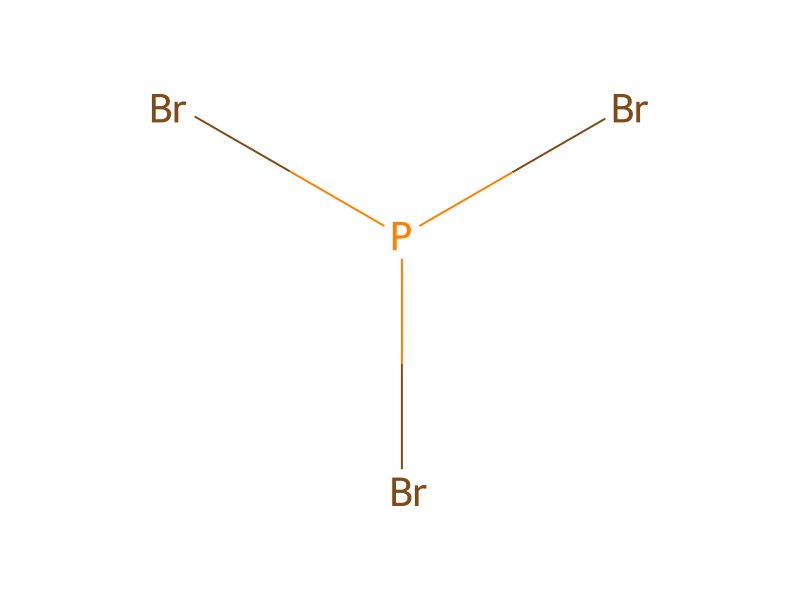
[C:1]1([CH2:17]O)[C:14]2[C:15]3=[C:16]4[C:11](=[CH:12][CH:13]=2)[CH:10]=[CH:9][CH:8]=[C:7]4[CH:6]=[CH:5][C:4]3=[CH:3][CH:2]=1.P(Br)(Br)[Br:20].CCOCC.O>C1C=CC=CC=1>[Br:20][CH2:17][C:1]1[C:14]2[C:15]3=[C:16]4[C:11](=[CH:12][CH:13]=2)[CH:10]=[CH:9][CH:8]=[C:7]4[CH:6]=[CH:5][C:4]3=[CH:3][CH:2]=1Participants
Reactant 4



Product 1

Reagents, catalysts & solvents 1

Procedure
A 10.00 g sample (43.1 mmol) of 1-Pyrenemethanol was dissolved in 250 mL of benzene with slight heating. The mixture was returned to room temperature and 1.63 mL (4.24 g, 17.24 mmol) of phosphorus tribromide were slowly added. The mixture was brought to reflux and stirred for 2 h. The mixture was returned to room temperature, and poured into a separatory funnel containing 500 mL 3:2 Et2O:H2O. The organic fraction was washed twice with 100 mL H2O and dried over anhydrous Na2SO4. Solvent was removed under reduced pressure to yield 1-(bromomethyl)pyrene (12.030 g, 95.0%) as a dark yellow powder. TLC (SiO2, 1:1 Hexane:EtOAc) Rƒ=0.95. Mp=270° C. (dec) 1H NMR (CDCl3), δ 5.28 (s, 2H), 8.0-8.3 (m, 9H from pyrene). 13C NMR (CDCl3), δ32.643, 123.258-132.374 16 pks from pyrene.
Workup
- customwas returned to room temperature
- temperatureto reflux
- customwas returned to room temperature
- additionpoured into a separatory funnel
- washThe organic fraction was washed twice with 100 mL H2O
- dry with materialdried over anhydrous Na2SO4
- customSolvent was removed under reduced pressure
Sources & evidence
- ORD record
- ord-9eee0dfdb83c4661b9b903eb632a880c
- Source dataset
- uspto-grants-2005_06
- Patent number
- US06902720B2
Reaction notes
Loading…