Reaction equation

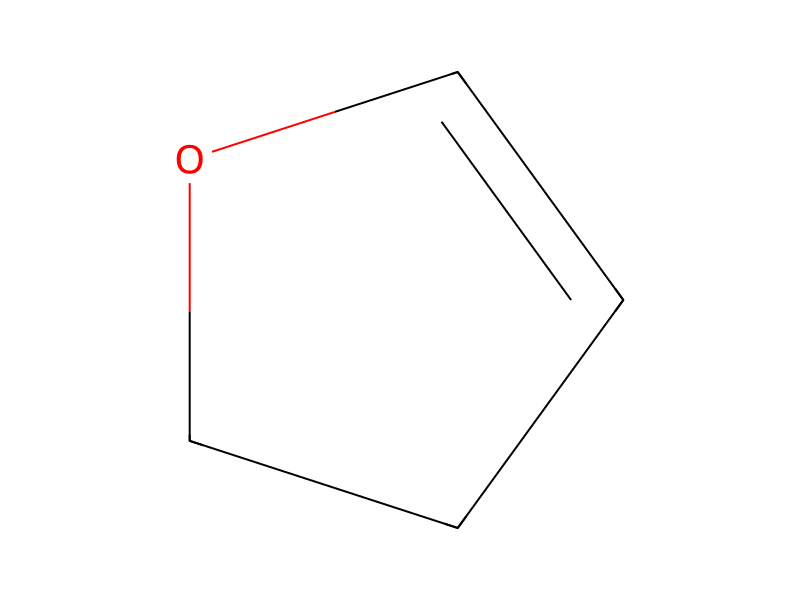
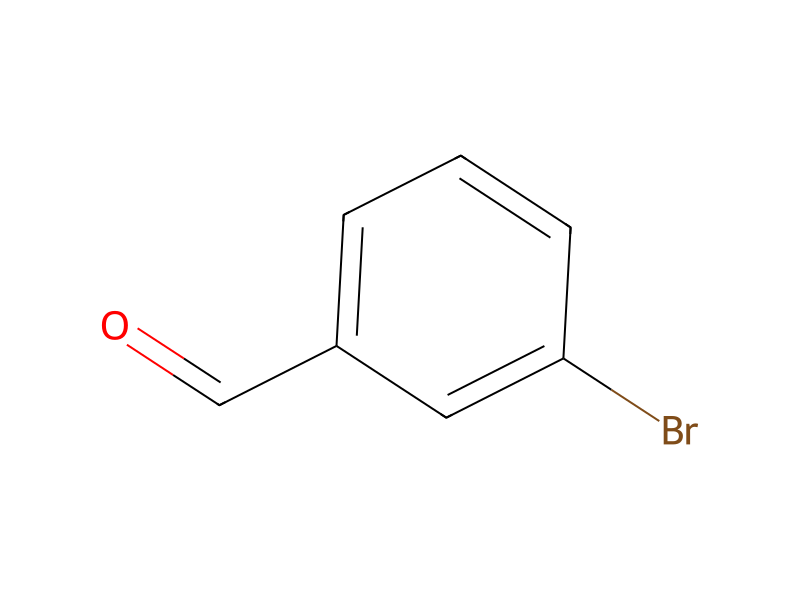
Br[C:2]1[CH:3]=[CH:4][CH:5]=[C:6]([CH:9]=1)[CH:7]=[O:8].[O:10]1[CH:14]=[CH:13][CH2:12][CH2:11]1.C(=O)([O-])[O-].[Cs+].[Cs+]>O1CCOCC1.O.CC(C)([P](C(C)(C)C)([Pd][P](C(C)(C)C)(C(C)(C)C)C(C)(C)C)C(C)(C)C)C>[O:10]1[CH:11]=[CH:12][CH2:13][CH:14]1[C:2]1[CH:9]=[C:6]([CH:5]=[CH:4][CH:3]=1)[CH:7]=[O:8]Participants





Conditions
- Temperature
- 45 °C
Procedure
Ex-119A: 5-Bromobenzaldehyde (0.5 g, 2.7 mmol) and 2,3-dihydrofuran (0.56 g, 8.1 mmol) were dissolved in dioxane (5.0 mL). Nitrogen was bubbled into the solution for 15 min followed by the sequential addition of cesium carbonate (0.96 g, 2.9 mmol) and bis(tri-t-butylphosphine)palladium(0) (0.014 g, 0.027 mmol). The solution was immediately heated to 45° C. and aged for 24 h. Upon completion, as determined by HPLC, the reaction was diluted with water (20 mL) and extracted with ethyl acetate (3×20 mL). The combined organic extracts were dried over sodium sulfate and concentrated to a brown oil. Silica gel chromatography (ethyl acetate/hexanes, 1:9) gave 0.18 g (40%) of 3-(2,3-dihydro-furan-2-yl)-benzaldehyde as a clear, colorless oil. 1H-NMR (300 MHz, CDCl3) δ 10.03 (s, 1H), 7.88 (s, 1H), 7.82 (d, 1H, J=7.2 Hz), 7.62–7.64 (m, 1H), 7.53 (t, 1H, J=7.2 Hz), 6.48 (q, 1H, J=Hz), 5.60 (dd, 1H, J=8.1, 10.8 Hz), 4.98 (q, 1H, J=3.3 Hz), 3.15 (ddt, 1H, J=15.0, 8.1, 2.5 Hz), 2.59 (ddt, 1H, J=15.0, 8.1, 2.5 Hz). MS (EI) m/z=174 ([M]+, 100%). HRMS (EI) Calcd. for C11H10O2: 174.0681. Found: 174.0677.
Workup
- customNitrogen was bubbled into the solution for 15 min
- extractionextracted with ethyl acetate (3×20 mL)
- dry with materialThe combined organic extracts were dried over sodium sulfate
- concentrationconcentrated to a brown oil
Sources & evidence
- ORD record
- ord-102420b016204a699014c908bf046c20
- Source dataset
- uspto-grants-2006_08
- Patent number
- US07094801B2
Linked notes
Loading…