Reaction equation

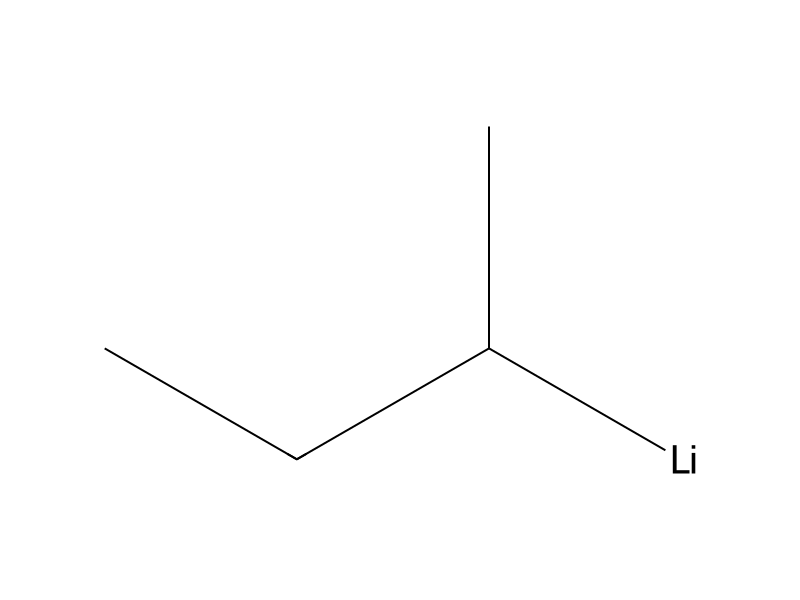
[C:1]([C:4]1[CH:9]=[CH:8][CH:7]=[C:6]([C:10]([CH3:12])=[CH2:11])[CH:5]=1)([CH3:3])=[CH2:2].C([Li:17])(CC)C.[CH3:18][CH2:19][CH2:20][CH2:21]CC>C1C=CC=CC=1>[Li:17][C:10]([C:6]1[CH:5]=[C:4]([CH:9]=[CH:8][CH:7]=1)[C:1]([CH3:3])=[CH2:2])([CH3:12])[CH2:11][CH:20]([CH3:21])[CH2:19][CH3:18]Participants
5
Reactant 3


Product 1

Reagents, catalysts & solvents 1

Procedure
316 g (2 moles) of 1,3-diisopropenyl benzene (DIPB) and 400 ml benzene are charged to a dry, argon flushed, 12-liter 3-neck, round-bottom reaction flask. The reaction flask is equipped with a stirrer, thermometer, addition funnel and a dry ice-hexane cooling bath. The flask and contents are cooled to -20° and a premixed solution of 1670 ml of a 1.2N sec-butyllithium in hexane (2 moles) and 202 g of TEA (2 moles) are added dropwise over a period of 2 hours. The temperature is held between -20° and -5° throughout the sec-butyllithium-TEA addition.
Workup
- customflushed
- customThe reaction flask is equipped with a stirrer
- additionthermometer, addition funnel and a dry ice-hexane cooling bath
- temperatureThe flask and contents are cooled to -20°
Sources & evidence
- ORD record
- ord-3e21b40c677d4119bb634b2944abb25d
- Source dataset
- uspto-grants-1976_05
- Patent number
- US03954894
Linked notes
Loading…