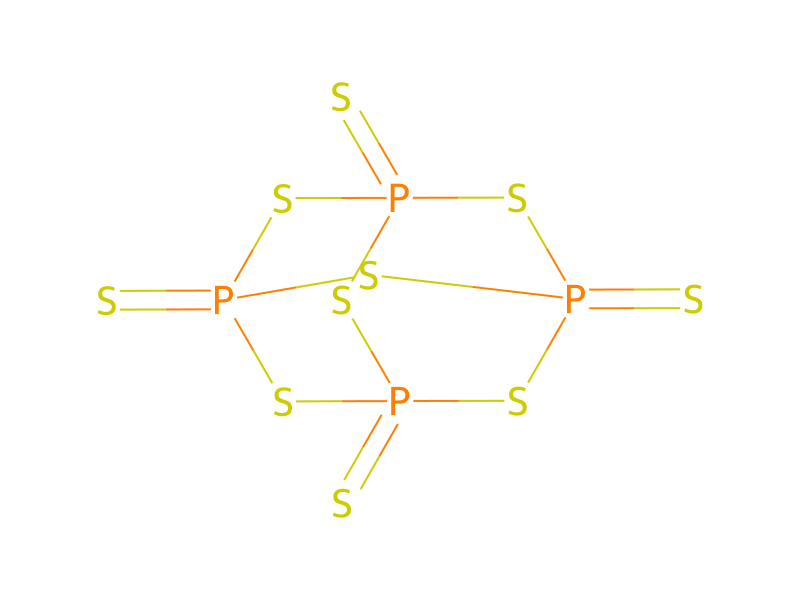
Phosphorus sulfide (P2S5) → HCID 24104717, compound
Reaction equation

[Cl:1][C:2]1[CH:17]=[CH:16][C:5]2[NH:6][C:7](=O)[C:8]3[CH:14]=[CH:13][CH:12]=[CH:11][C:9]=3[NH:10][C:4]=2[CH:3]=1.P12(SP3(SP(SP(S3)(S1)=S)(=S)S2)=S)=[S:19]>N1C=CC=CC=1>[Cl:1][C:2]1[CH:17]=[CH:16][C:5]2[NH:6][C:7](=[S:19])[C:8]3[CH:14]=[CH:13][CH:12]=[CH:11][C:9]=3[NH:10][C:4]=2[CH:3]=1Participants
4
Reactant 2

Product 1

Reagents, catalysts & solvents 1

Procedure
A mixture of 7-chloro-5,10-dihydro-11H-dibenzo[b,e]-[1,4]diazepin-11-one (30.5 g., 0.125 mole), phosphorus pentasulfide (27.8 g., 0.131 mole) and one l. of pyridine is heated at reflux temperature for 4 hours and the pyridine is evaporated in vacuo. The residue is stirred for 1 hour with one l. each of saturated aqueous sodium bicarbonate and methylene chloride and filtered to remove some solid product. The organic layer of the filtrate is washed successively with sodium bicarbonate solution and with saturated salt solution, dried over anhydrous magnesium sulfate and evaporated. The residue is combined with the solid obtained above and triturated with hot chloroform and methanol. In this way, 12.2 g. of 7-chloro-5,10-dihydro-11H-dibenzo[b,e][1,4]diazepine-11-thione of melting point 274°-275° C is obtained. Concentration of the chloroform-methanol washings affords an additional 8.4 g. of product having the same melting point. Recrystallization from dimethylformamide-water gives an analytically pure sample in the form of pale yellow needles of melting point 276°-277° C.