Reaction equation

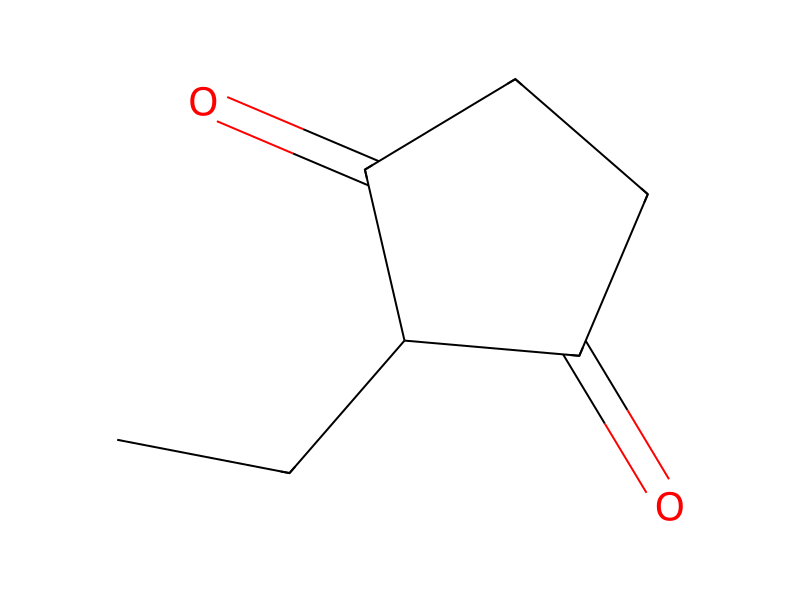
C(N(CC)[CH2:4][CH2:5][C:6](=[O:18])[CH2:7][CH2:8][CH2:9][C:10]1[CH:15]=[CH:14][CH:13]=[C:12]([O:16][CH3:17])[CH:11]=1)C.C=CC(=O)CCC.[CH2:28]([CH:30]1[C:34](=[O:35])[CH2:33][CH2:32][C:31]1=[O:36])[CH3:29]>[OH-].[K+]>[CH2:28]([C:30]1([CH2:4][CH2:5][C:6](=[O:18])[CH2:7][CH2:8][CH2:9][C:10]2[CH:15]=[CH:14][CH:13]=[C:12]([O:16][CH3:17])[CH:11]=2)[C:34](=[O:35])[CH2:33][CH2:32][C:31]1=[O:36])[CH3:29]Participants
Reactant 3


Product 1

Reagents, catalysts & solvents 1

Procedure
Referring now to FIG. 1, wherein the compounds are assigned Roman numerals for identification schematically, the sequence of reactions involved in the synthesis of a specific embodiment, namely, 13β,17α-diethyl-17β-hydroxygon-4-en-3-one, is illustrated. 3-(m-Methoxyphenyl)propanol (I) is heated with phosphorus tribromide in benzene after dropwise addition in the cold to form 3-(m-methoxyphenyl)propyl bromide (II). This halogen compound (II) dissolved in tetrahydrofuran is condensed with sodium acetylide in liquid ammonia to obtain 5-(m-methoxyphenyl)-1-pentyne (III). Compound III is allowed to stand under nitrogen with water, 30% formalin, acetic acid, diethylamine, dioxan, and cuprous chloride a 70°C for about 12 hours, whereby there is obtained 1-diethylamino-6-(m-methoxyphenyl)-2-hexyne (IV), which is in turn hydrated in the presence of a mercury salt and sulfuric acid to form 1-diethylamino-6-(m-methoxyphenyl)-3-hexanone (V). The ketamine (V) may eliminate diethylamine on distillation to give the vinyl ketone 6-m-methoxyphenyl)-1-hexen-3-one (VI). Either the ketamine (V) or the ketone (VI), or mixtures thereof, is then reacted with 2-ethyl-1,3-cyclopentanedione (VII) under Michael condensation conditions, e.g. refluxing in methanolic potassium hydroxide to form 2-ethyl-2-[6-(m-methoxyphenyl)-3-oxohexyl]-1,3-cyclopentanedione (VIII).
Sources & evidence
- ORD record
- ord-4d4ac04a045e42508c8c87b5443464b0
- Source dataset
- uspto-grants-1976_05
- Patent number
- US03959322
Linked notes
Loading…