HomeMCPWorkbenchSkills
HomeWorkbenchNotificationsMe
llms.txt · MCP GuidePrivacy Policy · Terms of Service · Supportv1.8.3
  1. Home
  2. /Reaction

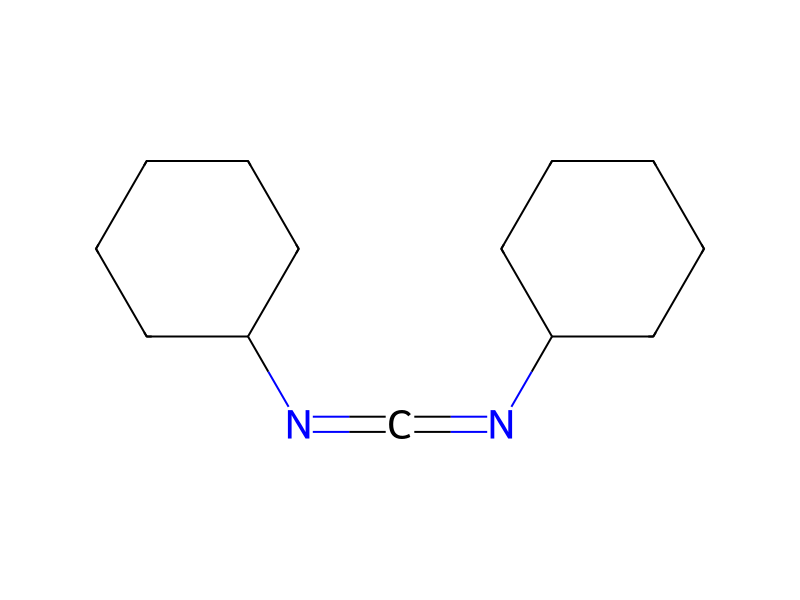
Dicyclohexylcarbodiimide → 2-(Pyrrolidin-1-yl)pyridine

HRID 1077381
Print

Reaction equation

HRID 1077381 reaction equation
C(O[C@H]1C[C@@H](O)C=C1)(=O)C.[CH2:11]1[CH2:16][CH2:15][CH:14]([N:17]=[C:18]=[N:19][CH:20]2[CH2:25][CH2:24][CH2:23]CC2)CC1>C(Cl)Cl>[N:19]1([C:18]2[CH:11]=[CH:16][CH:15]=[CH:14][N:17]=2)[CH2:20][CH2:25][CH2:24][CH2:23]1
ParticipantsProcedureWorkupSources & evidenceReaction notes

Participants

4

Reactant 2

HCID 10868DicyclohexylcarbodiimideHCID 98554984-Cyclopentene-1,3-diol, 1-acetate, (1R,3S)-rel-

Product 1

HCID 110190202-(Pyrrolidin-1-yl)pyridine

Reagents, catalysts & solvents 1

HCID 6344DichloromethaneSolvent

Procedure

3.1 mmol of the cyclopentenol, 3.1 mmol of DCC and 0.1 mmol of PP are dissolved in CH2Cl2 in a 100 ml flask fitted with a CaCl2 tube, 3.1 mmol of the carboxylic acid are added at 0°-5° C. with ice cooling, and the mixture is stirred at room temperature for 24 hours. The precipitated urea is filtered off, the solvent is removed by evaporation, and the crude product is recrystallized a number of times from ethanol.

On this pageParticipantsProcedureWorkupSources & evidenceReaction notes

Workup

  1. customfitted with a CaCl2 tube
  2. filtrationThe precipitated urea is filtered off
  3. customthe solvent is removed by evaporation
  4. customthe crude product is recrystallized a number of times from ethanol

Sources & evidence

ORD record
ord-6af82f90d71247dcb7e0ca8bd70bc64b
Source dataset
uspto-grants-1996_08
DOI
10.6084/m9.figshare.5104873.v1
Patent number
US05543076

Reaction notes