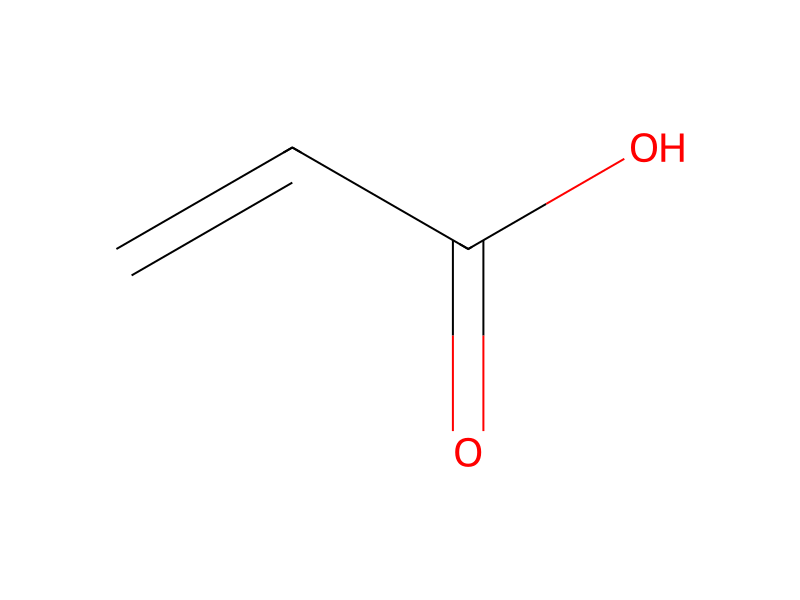
Acrylic Acid → Trichlorogermane propionic acid
HRID 1079042
Reaction equation

[Ge:1](Cl)([Cl:4])([Cl:3])[Cl:2].C[SiH2]O[Si](C)(C)C.[C:13]([OH:17])(=[O:16])[CH:14]=[CH2:15]>>[C:13]([OH:17])(=[O:16])[CH2:14][CH3:15].[Cl:2][GeH:1]([Cl:4])[Cl:3]Participants
4


Procedure
An example of this alternative process follows. To a 50 L glass reactor was added successively: 7.2 Kg germanium tetrachloride, 5.3 Kg tetramethyl disiloxane, and 2.32 Kg of acrylic acid. The resulting mixture was stirred for 5 days forming TPA (trichlorogermane propionic acid) as a product. Volatile components were removed via vacuum distillation while the TPA product was heated to an internal temperature of 75° C.-80° C., where it was a homogeneous, clear and colorless viscous melt. Distillation is continued until no more distillate appears. The product was then cooled to ambient temperature yielding a white amorphous solid of TPA. To this was added 35 L of concentrated HC1. The resulting heterogeneous mixture was warmed to an internal temperature of 60° C.-70° C., and stirred for four hours and allowed to cool. The cooled mixture was extracted 3 times with 25 L of dichloromethane. The dichloromethane was removed with vacuum distillation at 40° C. to give a white amorphous solid. The white amorphous solid, crude TPA, was then hydrolyzed to carboxyethyl germanium sesquioxide. To this end the crude TPA was immediately taken up (vigorous reaction), with careful addition of 30 L of ammonium hydroxide (29% ammonia). The resulting mixture was stirred for 4 days at ambient temperature. To this, 14.4 L of concentrated sulfuric acid was added dropwise over two hours through a reflux condenser producing a white solid of carboxyethyl germanium sesquioxide. The white solid was isolated via suction filtration, washed successively with 2×5.4 L acetone, and 2×5.4 L of diethyl ether, then the resulting brilliant white solid was air dried overnight, and then taken up with 9 L of hot water, then cooled and filtered to yield carboxyethyl germanium sesquioxide.