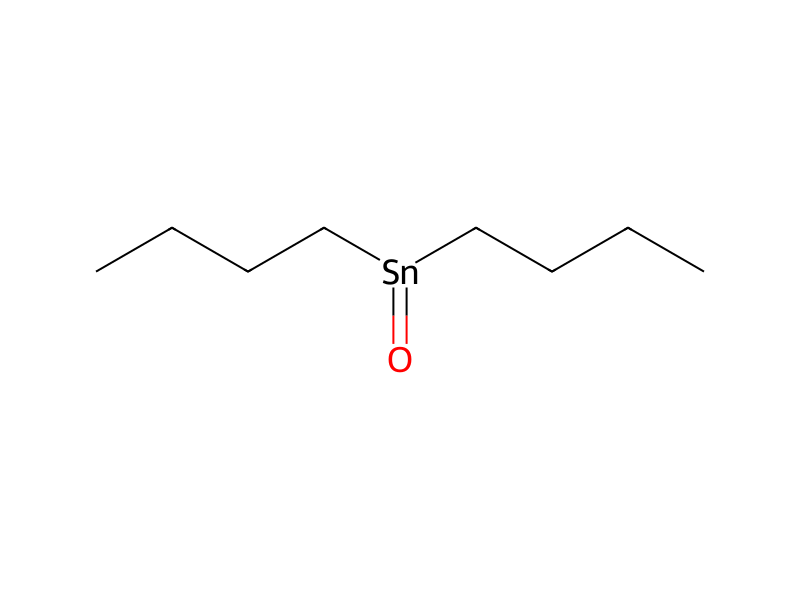
Dibutyltin oxide → Acetic acid,2,2'-[(dibutylstannylene)bis(thio)]bis-, 1,1'-diisooctyl ester
Reaction equation

[CH2:1]([Sn:5](=O)[CH2:6][CH2:7][CH2:8][CH3:9])[CH2:2][CH2:3][CH3:4].[CH2:11]([CH:19]([SH:23])[C:20]([O-:22])=[O:21])[CH2:12][CH2:13][CH2:14][CH2:15][CH:16]([CH3:18])[CH3:17]>>[CH2:11]([CH:19]([SH:23])[C:20]([O-:22])=[O:21])[CH2:12][CH2:13][CH2:14][CH2:15][CH:16]([CH3:17])[CH3:18].[CH2:11]([CH:19]([SH:23])[C:20]([O-:22])=[O:21])[CH2:12][CH2:13][CH2:14][CH2:15][CH:16]([CH3:17])[CH3:18].[CH2:1]([Sn+2:5][CH2:6][CH2:7][CH2:8][CH3:9])[CH2:2][CH2:3][CH3:4]Participants
3


Conditions
- Temperature
- 110 °C
Procedure
A suitable reactor was charged with 248.7 grams (1.0 mole) of dibutyltin oxide and 425.4 grams (2.05 moles) of isooctylthioglycolate of commercial purity. The reaction mixture was heated under vacuum, with agitation, to about 110° C. while distilling off water of reaction. On cooling and filtering, 656.1 grams of dibutyltin bis(isooctylthioglycolate) was obtained as an oily liquid.