HomeMCPWorkbenchSkills
HomeWorkbenchNotificationsMe
llms.txt · MCP GuidePrivacy Policy · Terms of Service · Supportv1.8.3
  1. Home
  2. /Reaction

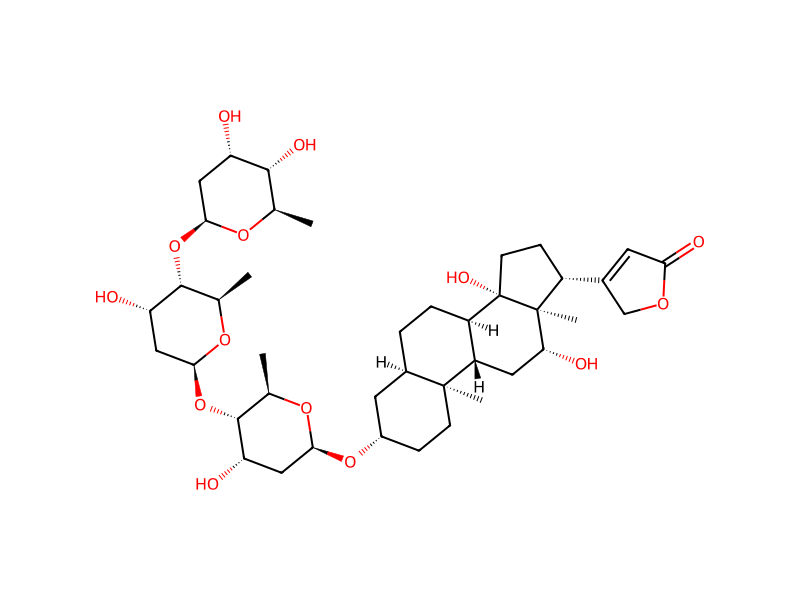
Water → Digoxin dialdehyde

HRID 1092639
Print

Reaction equation

HRID 1092639 reaction equation
[CH3:1][C@H:2]1[O:7][C@@H:6]([O:8][C@H:9]2[C@@H:14]([OH:15])[CH2:13][C@H:12]([O:16][C@H:17]3[C@@H:22]([OH:23])[CH2:21][C@H:20]([O:24][C@@H:25]4[CH2:30][C@H:29]5[CH2:31][CH2:32][C@H:33]6[C@@:38]7([OH:48])[CH2:39][CH2:40][C@H:41]([C:42]8[CH2:47][O:46][C:44](=[O:45])[CH:43]=8)[C@@:37]7([CH3:49])[C@H:36]([OH:50])[CH2:35][C@@H:34]6[C@@:28]5([CH3:51])[CH2:27][CH2:26]4)[O:19][C@@H:18]3[CH3:52])[O:11][C@@H:10]2[CH3:53])[CH2:5][C@H:4]([OH:54])[C@@H:3]1[OH:55].I([O-])(=O)(=O)=O.[Na+].O>C(Cl)(Cl)Cl.CO>[CH3:52][C@H:18]1[O:19][C@@H:20]([O:24][C@@H:25]2[CH2:30][C@H:29]3[CH2:31][CH2:32][C@H:33]4[C@@:38]5([OH:48])[CH2:39][CH2:40][C@H:41]([C:42]6[CH2:47][O:46][C:44](=[O:45])[CH:43]=6)[C@@:37]5([CH3:49])[C@H:36]([OH:50])[CH2:35][C@@H:34]4[C@@:28]3([CH3:51])[CH2:27][CH2:26]2)[CH2:21][C@H:22]([OH:23])[C@@H:17]1[O:16][C@@H:12]1[O:11][C@H:10]([CH3:53])[C@@H:9]([O:8][CH:6]([O:7][CH:2]([CH:3]=[O:55])[CH3:1])[CH2:5][CH:4]=[O:54])[C@@H:14]([OH:15])[CH2:13]1
ParticipantsProcedureWorkupSources & evidenceReaction notes

Participants

5

Reactant 3

HCID 962WaterHCID 2724385DigoxinHCID 23667635Sodium periodate

Product 1

HCID 101931782Digoxin dialdehyde

Reagents, catalysts & solvents 1

HCID 21584188Chloroform methanolSolvent

Procedure

To a solution of digoxin (2.30 g, 2.95 mmol, Sigma Chemical Co., St. Louis, Mo.) in 24 mL of chloroform:methanol (1:1) was added sodium periodate (0.699 g, 3.27 mmol, Aldrich Chemical Co.) and 1.0 mL water. The solution was stirred at room temperature for 18 hr. The sodium iodate precipitate was removed via filtration. Following solvent removal on rotary evaporator the residue was dissolved in 50 mL chloroform, washed 1×8 mL water, and dried over magnesium sulfate. The solvent was removed on a rotary evaporator and the residue was recrystalized from chloroform/hexane resulting in the formation of an oil. Crystal formation was initiated by the addition of a small amount of diethyl ether yielding 2.22 g (96.6%) amorphous, white solid. TLC: silica gel; acetonitrile/water; 1/1; Rf=0.88 after development with 2,4-dinitrophenyl hydrazine (Aldrich Chemical Co.).

Workup

  1. customThe sodium iodate precipitate was removed via filtration
  2. customFollowing solvent removal
  3. customon rotary evaporator the residue
  4. dissolutionwas dissolved in 50 mL chloroform
  5. washwashed 1×8 mL water
  6. dry with materialdried over magnesium sulfate
  7. customThe solvent was removed on a rotary evaporator
  8. customthe residue was recrystalized from chloroform/hexane resulting in the formation of an oil
  9. additionCrystal formation was initiated by the addition of a small amount of diethyl ether yielding 2.22 g (96.6%) amorphous, white solid

Sources & evidence

ORD record
ord-347d055192ae4493b75f9d1a71321553
Source dataset
uspto-grants-2012_03
DOI
10.6084/m9.figshare.5104873.v1
Patent number
US08129509B2

Reaction notes

On this pageParticipantsProcedureWorkupSources & evidenceReaction notes