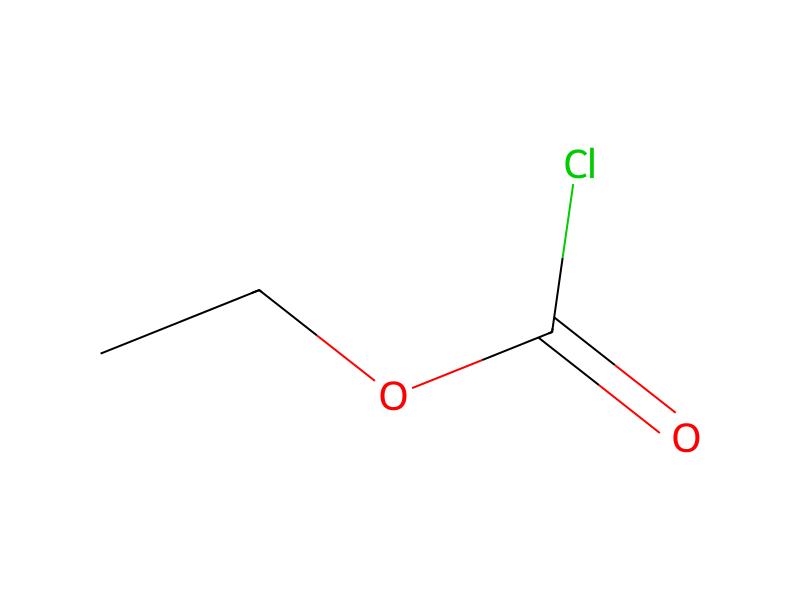
Ethyl chloroformate → 1,3-Bis(2',6'-dimethylphenyl)-2-carbethoxyimino-4-methyl-imidazolidine
HRID 1164464
Reaction equation

Cl[C:2]([O:4][CH2:5][CH3:6])=[O:3].[CH3:7][C:8]1[CH:13]=[CH:12][CH:11]=[C:10]([CH3:14])[C:9]=1[N:15]1[CH2:19][CH:18]([CH3:20])[N:17]([C:21]2[C:26]([CH3:27])=[CH:25][CH:24]=[CH:23][C:22]=2[CH3:28])[C:16]1=[NH:29]>C1C=CC=CC=1>[CH3:7][C:8]1[CH:13]=[CH:12][CH:11]=[C:10]([CH3:14])[C:9]=1[N:15]1[CH2:19][CH:18]([CH3:20])[N:17]([C:21]2[C:22]([CH3:28])=[CH:23][CH:24]=[CH:25][C:26]=2[CH3:27])[C:16]1=[N:29][C:2]([O:4][CH2:5][CH3:6])=[O:3]Participants
4
Reactant 2

Product 1

Reagents, catalysts & solvents 1

Procedure
A solution of 1.0 ml (1.38 g, 10.5 mmoles) of ethyl chloroformate in 10 ml of dry benzene is added dropwise at room temperature to a stirred solution of 6.15 g (20 mmoles) of 1,3-bis(2',6'-dimethylphenyl)-2-imino-4-methyl-imidazolidine, obtained as described in Example 7, in 60 ml of dry benzene. The mixture is stirred for additional 5 hours at room temperature, and then washed thrice with 50 ml of water each. The benzene solution is dried over anhydrous sodium sulfate, and the solvent is evaporated under reduced pressure. The thick, yellow oily residue is crystallized from diisopropyl ether to obtain 2.7 g (71.2%) of 1,3-bis(2',6'-dimethylphenyl)-2-carbethoxyimino-4-methyl-imidazolidine; m.p.: 124°-125° C.