Reaction equation

[Br:1][C:2]1[S:6][C:5](Br)=[C:4]([Br:8])[C:3]=1[Br:9].C([Li])CCC.[C:15](OCC)(=[O:21])[C:16]([O:18][CH2:19][CH3:20])=[O:17]>>[CH2:19]([O:18][C:16](=[O:17])[C:15]([C:5]1[S:6][C:2]([Br:1])=[C:3]([Br:9])[C:4]=1[Br:8])=[O:21])[CH3:20]Participants

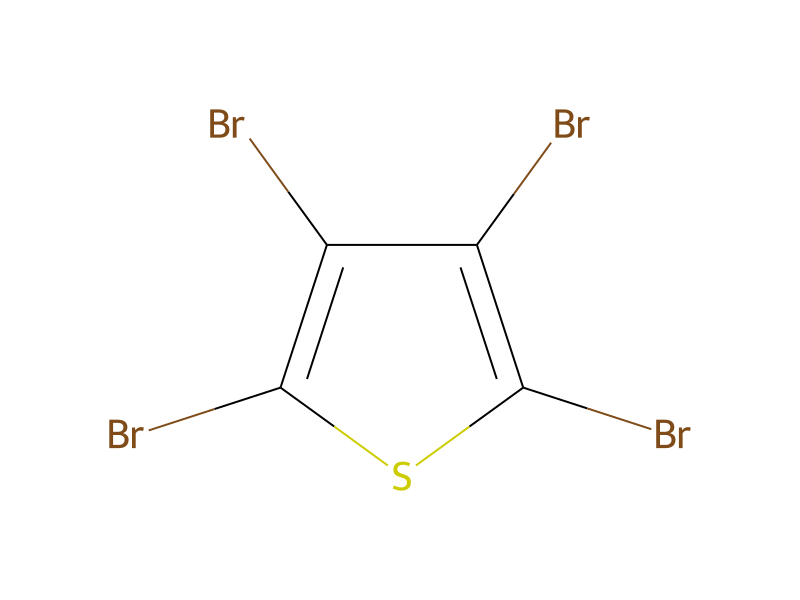


Conditions
- Temperature
- -18 °C
Procedure
To tetrabromothiophene (2.0 g, 5.0 mmol) in an oven dried 50 mL flask, evacuated and flushed with nitrogen, was added anhydrous diethyl ether (12 ml). The resulting solution was cooled to −18° C., then n-butyllithium (1.6 M in hexane) (3.1 ml, 5.0 mmol ) was added dropwise via a syringe. After stirring for 10 min at −18° C., diethyl oxalate (0.75 ml, 5.5 mmol) was added dropwise. Stirring was continued for 30 min, then the reaction mixture was quenched with 1N HCl. The organic layer was separated, dried over Na2SO4 and concentrated under vacuum. Purification was performed by column chromatography using hexane/ethyl acetate (20:1) to yield (3,4,5-tribromothiophen-2-yl)-oxo-acetic acid ethyl ester as a yellow solid (1.5 g, 71%). MS (M+H)+: 422.55; 1H NMR (300 MHz, CDCl3) δ4.45 (2H, q, J=7.1 Hz), 1.44 (3H, t, J=7.1 Hz). 13C NMR (75 MHz, CDCl3) δ173.89, 161.64, 133.35, 124.81, 123.05, 122.54, 63.75, 14.11.
Workup
- customevacuated
- customflushed with nitrogen
- additionwas added anhydrous diethyl ether (12 ml)
- stirringStirring
- waitwas continued for 30 min
- customthe reaction mixture was quenched with 1N HCl
- customThe organic layer was separated
- dry with materialdried over Na2SO4
- concentrationconcentrated under vacuum
- customPurification
Sources & evidence
- ORD record
- ord-885df1cb6ab84dbcbca378dcb9067489
- Source dataset
- uspto-grants-2003_09
- Patent number
- US06613786B2
Linked notes
Loading…