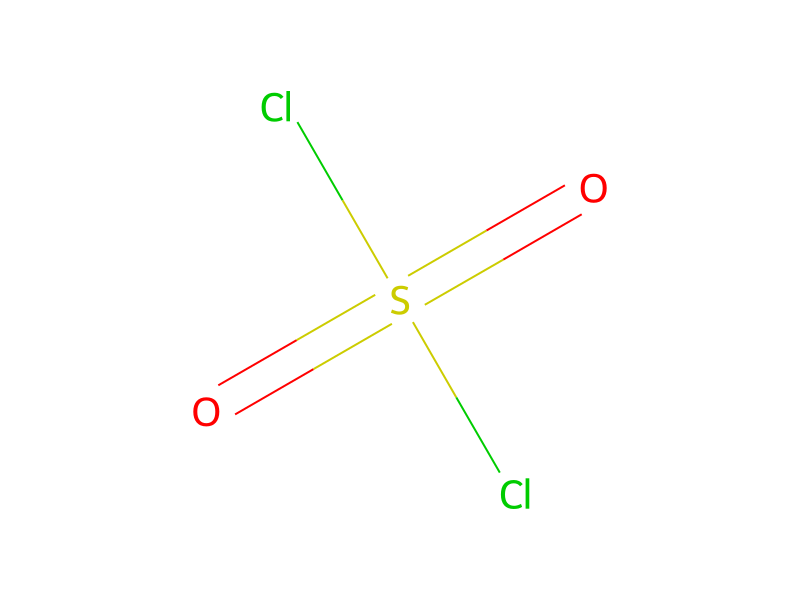
Sulfuryl chloride → 4-(4-Bromophenyl)-5-chloro-2-(2-cyano-acetylamino)-thiophene-3-carboxylic acid ethyl ester
HRID 1244093
Reaction equation

[CH2:1]([O:3][C:4]([C:6]1[C:10]([C:11]2[CH:16]=[CH:15][C:14]([Br:17])=[CH:13][CH:12]=2)=[CH:9][S:8][C:7]=1[NH:18][C:19](=[O:23])[CH2:20][C:21]#[N:22])=[O:5])[CH3:2].S(Cl)([Cl:27])(=O)=O>C(Cl)Cl>[CH2:1]([O:3][C:4]([C:6]1[C:10]([C:11]2[CH:16]=[CH:15][C:14]([Br:17])=[CH:13][CH:12]=2)=[C:9]([Cl:27])[S:8][C:7]=1[NH:18][C:19](=[O:23])[CH2:20][C:21]#[N:22])=[O:5])[CH3:2]Participants
4



Procedure
To a cold (0° C.) solution of 4-(4-bromophenyl)-2-(2-cyano-acetylamino)-thiophene-3-carboxylic acid ethyl ester (4.0 g, 10.18 mmol) in methylene chloride (34 mL) was added sulfuryl chloride (0.82 mL, 10.2 mmol). The cold bath was removed, and the reaction was stirred at room temperature for 4 h. Saturated aqueous sodium bicarbonate solution was then added (30 mL) to the reaction. The layers were separated, and the aqueous was extracted with additional methylene chloride (3×15 mL). The combined organic layers were dried with anhydrous sodium sulfate, filtered, and concentrated under reduced pressure to give the titled compound as a solid. MS (DCI/NH3) m/e 446 (M+NH3)+, NMR (300 MHz, CDCl3): δ ppm 12.1 (br s, 1H), 7.53 d, 2H), 7.09 (d, 2H), 4.08 (q, 2H), 3.67 (s, 2H), and 0.91 (t, 3H).