Reaction equation
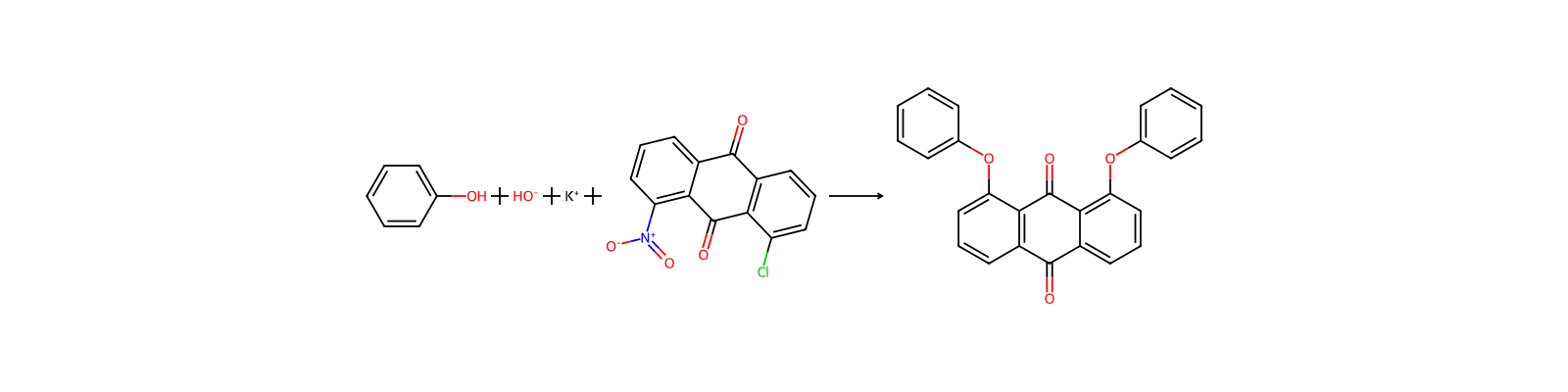
[C:1]1([OH:7])[CH:6]=[CH:5][CH:4]=[CH:3][CH:2]=1.[OH-:8].[K+].Cl[C:11]1[C:24]2[C:23](=[O:25])[C:22]3[C:17](=[CH:18][CH:19]=[CH:20][C:21]=3[N+]([O-])=O)[C:16](=[O:29])[C:15]=2[CH:14]=[CH:13][CH:12]=1>>[O:7]([C:11]1[C:24]2[C:23](=[O:25])[C:22]3[C:17](=[CH:18][CH:19]=[CH:20][C:21]=3[O:8][C:1]3[CH:6]=[CH:5][CH:4]=[CH:3][CH:2]=3)[C:16](=[O:29])[C:15]=2[CH:14]=[CH:13][CH:12]=1)[C:1]1[CH:6]=[CH:5][CH:4]=[CH:3][CH:2]=1Participants
4




Conditions
- Temperature
- 100 °C
Procedure
A mixture of 21 g. phenol, 13 g. potassium hydroxide and 270 g. o-chlorotoluene was converted to a water-free slurry of potassium phenoxide by azeotropic distillation of all the water formed. After cooling back to 100° C., 28.8 g. of 1-chloro-8-nitroanthraquinone was charged and the whole heated and stirred at 130° C. for 6 hours. The product was isolated by steam distillation, filtration, washing and drying. A 37.7 g. yield (96.2% of theory) of a product identical to authentic 1,8-diphenoxyanthraquinone in a thin layer chromatogram and free of starting material was obtained.
Workup
- additionA mixture of 21 g
- distillationo-chlorotoluene was converted to a water-free slurry of potassium phenoxide by azeotropic distillation of all the water
- customformed
- temperaturethe whole heated
- customThe product was isolated by steam distillation, filtration
- washwashing
- customdrying
Sources & evidence
- ORD record
- ord-a1f80f2135794476b69ab2f82b7dcaa3
- Source dataset
- uspto-grants-1981_03
- Patent number
- US04255342
Linked notes
Loading…