Dimethylamine → N-(2-chloro-5-thiazolylmethyl)-N',N'-dimethyl-N"-nitroguanidine
Reaction equation

[CH3:1][NH:2][CH3:3].[Cl:4][C:5]1[S:6][C:7]([CH2:10][NH:11][C:12](=[N:15][N+:16]([O-:18])=[O:17])SC)=[CH:8][N:9]=1>C(#N)C>[Cl:4][C:5]1[S:6][C:7]([CH2:10][NH:11][C:12]([N:2]([CH3:3])[CH3:1])=[N:15][N+:16]([O-:18])=[O:17])=[CH:8][N:9]=1Participants
4
Reactant 2
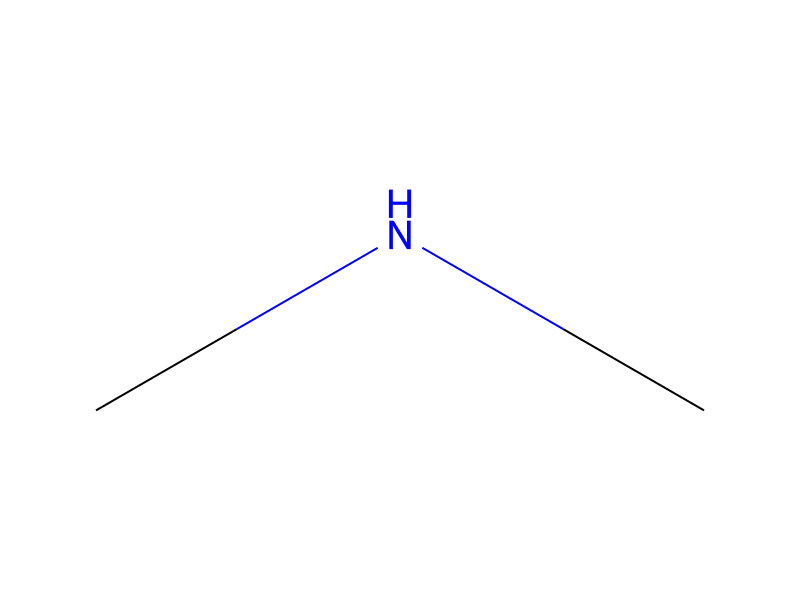

Product 1

Reagents, catalysts & solvents 1

Procedure
252 mg of a 50% aqueous dimethylamine solution was dropwise added to a mixture consisting of 600 mg N-(2-chloro-5-thiazolylmethyl)-S-methyl-N'-nitroisothiourea and 20 ml acetonitrile at room temperature. After stirring at room temperature for 2 hours the reaction mixture was concentrated and 20 ml of ethanol was added to the residue, followed by stirring thoroughly. The resultant crystals were collected by filtration and dried to afford 350 mg of N-(2-chloro-5-thiazolylmethyl)-N',N'-dimethyl-N"-nitroguanidine (compound No.17) as a white powder. The mothor liquor after the filtration was concentrated and 5 ml of ethanol was added, followed by stirring thoroughly, then the resultant crystals were collected by filtration and dried to give additional 120 mg of compound No.17 (mp 154-159° C.). Recrystallization of this product from acetonitrile afforded a product having a melting point of 164-166° C.