HomeMCPWorkbenchSkills
HomeWorkbenchNotificationsMe
llms.txt · MCP GuidePrivacy Policy · Terms of Service · Supportv1.8.3
  1. Home
  2. /Reaction

N-(5-bromo-2-fluorophenyl)acetamide → Ammonia

HRID 130408
Print

Reaction equation

HRID 130408 reaction equation
Br[C:2]1[CH:3]=[CH:4][C:5]([F:12])=[C:6]([NH:8][C:9](=[O:11])[CH3:10])[CH:7]=1.[CH3:13][C@H:14]1[CH2:19][NH:18][CH2:17][C@@H:16]([CH3:20])[NH:15]1.CC(C)([O-])C.[Na+].C1(P(C2CCCCC2)C2C=CC=CC=2C2C=CC=CC=2N(C)C)CCCCC1>O1CCOCC1.C1C=CC(/C=C/C(/C=C/C2C=CC=CC=2)=O)=CC=1.C1C=CC(/C=C/C(/C=C/C2C=CC=CC=2)=O)=CC=1.C1C=CC(/C=C/C(/C=C/C2C=CC=CC=2)=O)=CC=1.[Pd].[Pd]>[NH3:8].[CH3:13][C@H:14]1[NH:15][C@@H:16]([CH3:20])[CH2:17][N:18]([C:2]2[CH:3]=[CH:4][C:5]([F:12])=[C:6]([NH:8][C:9](=[O:11])[CH3:10])[CH:7]=2)[CH2:19]1
ParticipantsProcedureWorkupSources & evidenceReaction notes

Participants

8

Reactant 4

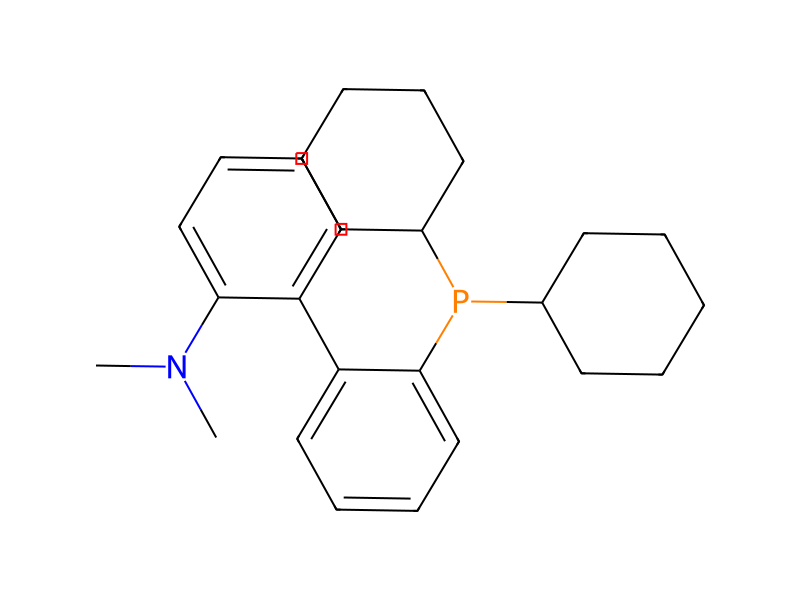
HCID 242827N-(5-bromo-2-fluorophenyl)acetamideHCID 27342172-(Dicyclohexylphosphino)-2'-(dimethylamino)biphenylHCID 6950261rel-(2R,6S)-2,6-dimethylpiperazineHCID 23676156Sodium t-butoxide

Product 2

HCID 222AmmoniaYield 10%
HCID 69198003
N-[5-(cis-3,5-Dimethyl-1-piperazinyl)-2-fluorophenyl]acetamide

Reagents, catalysts & solvents 2

HCID 9811564Bis(dibenzylideneacetone)palladiumCatalystHCID 312751,4-DioxaneSolvent

Procedure

The product of Step 1 (5.12 g, 18.7 mmol), cis-2,6-dimethyl piperazine (3.20 g, 28.1 mmol), sodium tert-butoxide (5.39 g, 56.1 mmol), tris(dibenzylideneacetone)dipalladium(0) (343 mg, 0.37 mmol) and 2-dicyclohexylphosphino-2′-(N,N-dimethylamino)biphenyl (444 mg, 1.12 mmol) were heated at reflux for 16 hours in 1,4-dioxane (50 ml). The solution was filtered through celite washing through with ethyl acetate. The filtrate was concentrated in vacuo, and the residue partitioned between ethyl acetate and saturated aqueous sodium bicarbonate solution. The organic phase was washed with water, 50% saturated brine solution, brine, dried over anhydrous sodium sulfate and concentrated in vacuo. The residue was purified by chromatography on silica gel (ethyl acetate, then a gradient of dichloromethane to 10% 2M methanolic ammonia in dichloromethane) to afford the title compound. MS (ES+) m/e 266 [M+H]+.

Workup

  1. filtrationThe solution was filtered through celite
  2. washwashing through with ethyl acetate
  3. concentrationThe filtrate was concentrated in vacuo
  4. customthe residue partitioned between ethyl acetate and saturated aqueous sodium bicarbonate solution
  5. washThe organic phase was washed with water, 50% saturated brine solution, brine
  6. dry with materialdried over anhydrous sodium sulfate
  7. concentrationconcentrated in vacuo
  8. customThe residue was purified by chromatography on silica gel (ethyl acetate

Sources & evidence

ORD record
ord-b822db0c06684382beca792c1e828e8f
Source dataset
uspto-grants-2008_06
DOI
10.6084/m9.figshare.5104873.v1
Patent number
US07381728B2

Reaction notes

On this pageParticipantsProcedureWorkupSources & evidenceReaction notes


