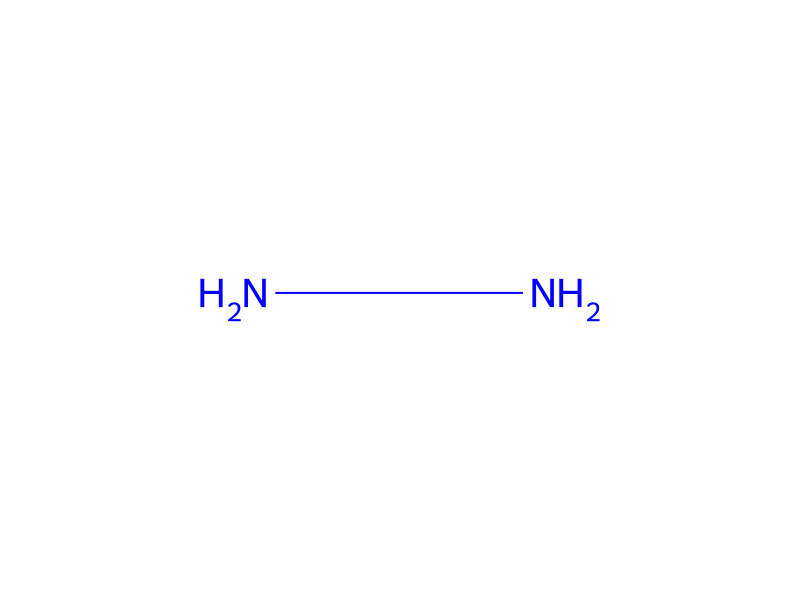
Hydrazine → 2-Hydrazino-5,6-dihydrobenzo[h]quinazoline
HRID 1400093
Reaction equation

Cl[C:2]1[N:11]=[CH:10][C:9]2[CH2:8][CH2:7][C:6]3[CH:12]=[CH:13][CH:14]=[CH:15][C:5]=3[C:4]=2[N:3]=1.[NH2:16][NH2:17]>N1C=CC=CC=1>[NH:16]([C:2]1[N:11]=[CH:10][C:9]2[CH2:8][CH2:7][C:6]3[CH:12]=[CH:13][CH:14]=[CH:15][C:5]=3[C:4]=2[N:3]=1)[NH2:17]Participants
4
Reactant 2

Product 1

Reagents, catalysts & solvents 1

Procedure
Crude 2-chloro-5,6-dihydrobenzo[h]quinazoline was heated at 120° C. in a mixture of anhydrous pyridine (20 mL) and anhydrous hydrazine (7 mL) for 4 h. The solvent was removed under vacuum and the residue was partitioned between chloroform and 1M aqueous potassium carbonate solution. The organic layer was dried over anhydrous sodium sulfate and concentrated under vacuum to give 2-hydrazinyl-5,6-dihydrobenzo[h]quinazoline as a white solid, 2.16 g. 1H NMR (CDCl3, 300 MHz) 8.27 (d, 1H), 8.20 (s, 1H), 7.35 (m, 2H), 7.21 (d, 1H), 6.42 (s, 1H), 4.00 (br s, 2H), 2.91 (m, 2H), 2.80 (m, 2H) ppm; 13C NMR (CDCl3, 75 MHz) 164.29, 160.00, 156.72, 139.87, 132.83, 131.02, 128.25, 127.25, 125.47, 119.03, 28.54, 24.24; MS (ES) 213 (M+H).