Reaction equation
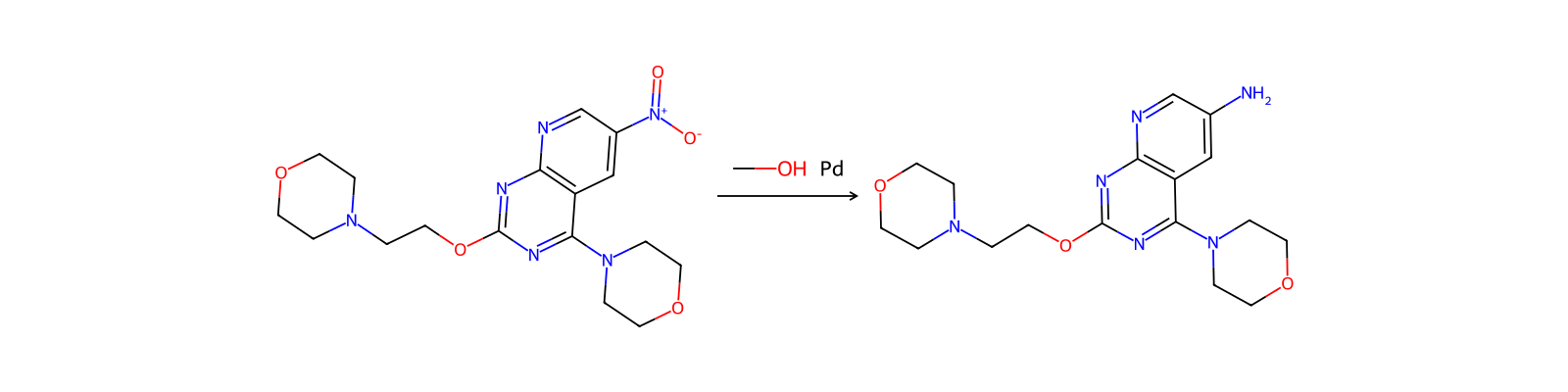
[N:1]1([C:7]2[C:8]3[CH:25]=[C:24]([N+:26]([O-])=O)[CH:23]=[N:22][C:9]=3[N:10]=[C:11]([O:13][CH2:14][CH2:15][N:16]3[CH2:21][CH2:20][O:19][CH2:18][CH2:17]3)[N:12]=2)[CH2:6][CH2:5][O:4][CH2:3][CH2:2]1>CO.[Pd]>[N:1]1([C:7]2[C:8]3[CH:25]=[C:24]([NH2:26])[CH:23]=[N:22][C:9]=3[N:10]=[C:11]([O:13][CH2:14][CH2:15][N:16]3[CH2:21][CH2:20][O:19][CH2:18][CH2:17]3)[N:12]=2)[CH2:2][CH2:3][O:4][CH2:5][CH2:6]1Participants
4




Procedure
4-Morpholin-4-yl-2-(2-morpholin-4-yl-ethoxy)-6-nitro-pyrido[2,3-d]pyrimidine (3.35 g) was dissolved in methanol (100 mL), and to the solution was added 5% palladium on carbon (100 mg). The suspension was placed under an atmosphere of hydrogen, and stirred for five hours. The solution was filtered and evaporated, and then purified by column chromatography to give 4-morpholin-4-yl-2-(2-morpholin-4-yl-ethoxy)-6-amino-pyrido[2,3-d]pyrimidine (1.45 g) as a yellow oil.
Workup
- filtrationThe solution was filtered
- customevaporated
- custompurified by column chromatography
Sources & evidence
- ORD record
- ord-e066826676ff40efb82716f3e56219fb
- Source dataset
- uspto-grants-2009_11
- Patent number
- US07615552B2
Linked notes
Loading…