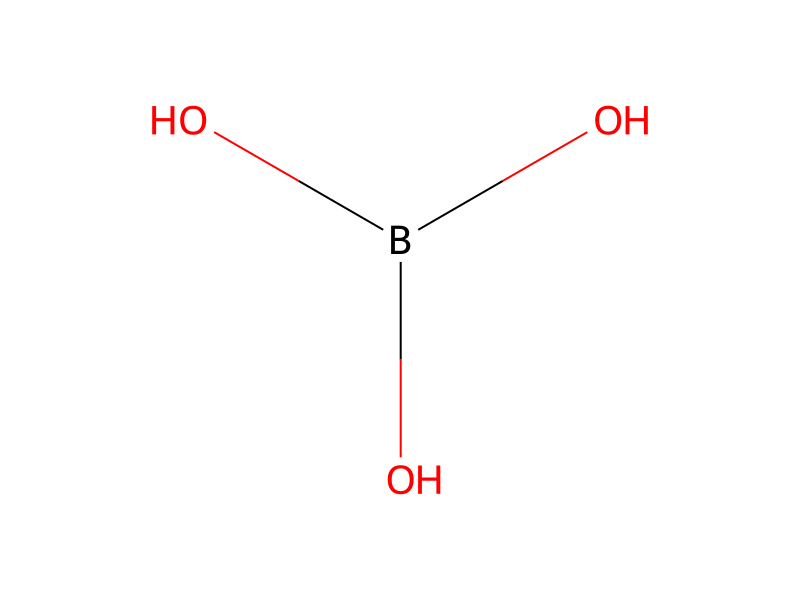
Trimethyl borate → Boric Acid
Reaction equation

[B:1]([O:6][CH3:7])([O:4][CH3:5])[O:2][CH3:3].C(O)(=O)C(C)=C.CC(O)COC(CO)C.COC(COC(COC(CO)C)C)C>>[B:1]([OH:6])([OH:4])[OH:2].[B:1]([O:6][CH3:7])([O:4][CH3:5])[O:2][CH3:3]Participants
5



Conditions
- Temperature
- 75 °C
Procedure
207.6 Grams (2.0 mols) of trimethyl borate was added to 202 g (1.0 mol) of dipropylene glycol monomethacrylate and 412 g (2.0 mols) of tripropylene glycol monomethyl ether, followed by keeping them at 60° C. for 1 hour with stirring in a dry air atmosphere and then heating to 75° C. After the temperature reached 75° C., the pressure in the system was gradually reduced. The system was kept at a pressure of 2.67 kPa (20 mmHg) or lower for 6 hours to remove volatile matters produced with progress of ester interchange reaction of boric acid and excess trimethyl borate, followed by filtration to obtain 610 g of the polymerizable boron-containing compound B represented by the formula (1). An infrared absorption spectrum of the resulting polymerizable boron-containing compound B was measured to confirm that the absorption band originating from hydroxyl group at 3300 cm−1 disappeared.