4-Fluorobenzylamine → N-[(4-fluorophenyl)methyl]-3-hydroxy-5-methyl-4-oxo-7-(3-pyridyl)-6,7-dihydropyrazolo[1,5-a]pyrazine-2-carboxamide
Reaction equation

[OH:1][C:2]1[C:3]([C:19](OC)=[O:20])=[N:4][N:5]2[CH:10]([C:11]3[CH:12]=[N:13][CH:14]=[CH:15][CH:16]=3)[CH2:9][N:8]([CH3:17])[C:7](=[O:18])[C:6]=12.[F:23][C:24]1[CH:31]=[CH:30][C:27]([CH2:28][NH2:29])=[CH:26][CH:25]=1>CO>[F:23][C:24]1[CH:31]=[CH:30][C:27]([CH2:28][NH:29][C:19]([C:3]2[C:2]([OH:1])=[C:6]3[C:7](=[O:18])[N:8]([CH3:17])[CH2:9][CH:10]([C:11]4[CH:12]=[N:13][CH:14]=[CH:15][CH:16]=4)[N:5]3[N:4]=2)=[O:20])=[CH:26][CH:25]=1Participants
4
Reactant 2
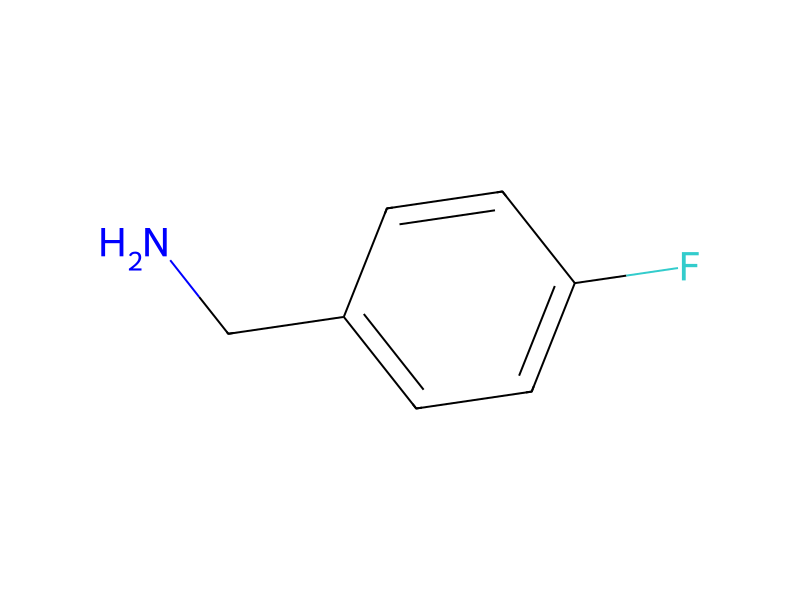

Product 1

Reagents, catalysts & solvents 1

Procedure
Methyl 3-hydroxy-5-methyl-4-oxo-7-pyridin-3-yl-4,5,6,7-tetrahydropyrazolo[1,5-a]pyrazine-2-carboxylate (40 mg, 0.13 mmol) and 4-fluorobenzylamine (130 mg, 1.06 mmol) were combined in MeOH (0.5 mL) and the mixture was heated to reflux, allowing the solvent to slowly evaporate over 18 hours. The residue was purified by preparative HPLC (Waters Nova Pak column (100×40 mm I.D. cartridge, C18, 6 μM pore size) eluting with 95-5% water (0.1% TFA)/acetonitrile (0.1% TFA) at 35 mL/minute.). The appropriate fractions were combined and the solvent was removed to give the title compound as a gum. 1H NMR (400 MHz, d6-DMSO) δ 8.77 (t, J=6 Hz, 1H), 8.67 (s, 1H), 8.53 (s, 1H), 7.6-7.7 (m, 2H), 7.33 (dd, J=5.7, 8.6 Hz, 2H), 7.13 (t, J=9.0 Hz, 2H), 5.90 (t, J=4.6 Hz, 1H), 4.39 (ABX, J=15, 6.1 Hz, 2H), 4.19 (dd, J=13, 4.6 Hz, 1H), 3.91 (dd, J=13, 4.5 Hz, 1H), 2.91 (s, 3H); ES MS (M+1)=396.