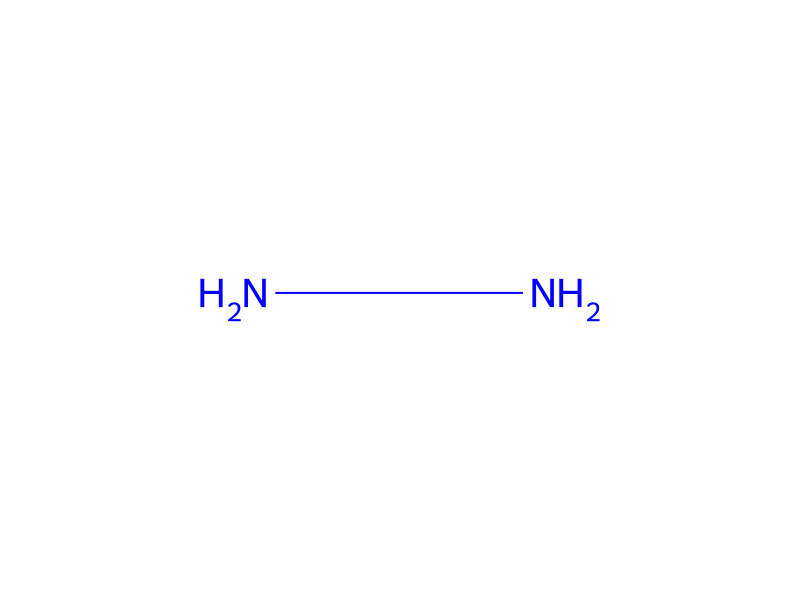
Hydrazine → N-(1-(2-aminoethyl)-3-(5-chloro-2-methoxyphenyl)-1H-pyrazol-4-yl)pyrazolo[1,5-a]pyrimidine-3-carboxamide
HRID 1466589
Reaction equation

[Cl:1][C:2]1[CH:3]=[CH:4][C:5]([O:38][CH3:39])=[C:6]([C:8]2[C:12]([NH:13][C:14]([C:16]3[CH:17]=[N:18][N:19]4[CH:24]=[CH:23][CH:22]=[N:21][C:20]=34)=[O:15])=[CH:11][N:10]([CH2:25][CH2:26][N:27]3C(=O)C4C(=CC=CC=4)C3=O)[N:9]=2)[CH:7]=1.NN>C(O)C>[NH2:27][CH2:26][CH2:25][N:10]1[CH:11]=[C:12]([NH:13][C:14]([C:16]2[CH:17]=[N:18][N:19]3[CH:24]=[CH:23][CH:22]=[N:21][C:20]=23)=[O:15])[C:8]([C:6]2[CH:7]=[C:2]([Cl:1])[CH:3]=[CH:4][C:5]=2[O:38][CH3:39])=[N:9]1Participants
4
Reactant 2

Product 1

Reagents, catalysts & solvents 1

Procedure
To a solution of N-(3-(5-chloro-2-methoxyphenyl)-1-(2-(1,3-dioxoisoindolin-2-yl)ethyl)-1H-pyrazol-4-yl)pyrazolo[1,5-a]pyrimidine-3-carboxamide (prepared following the synthetic procedures described for Example 14) (104.1 mg, 0.192 mmol) in 8 mL ethanol was added hydrazine (78 μL, 2.5 mmol). The reaction mixture was stirred at room temperature for 18 hours, and then concentrated. The crude product was purified by reverse phase HPLC and lyophilized to give 17.7 mg (15.4%) of N-(1-(2-aminoethyl)-3-(5-chloro-2-methoxyphenyl)-1H-pyrazol-4-yl)pyrazolo[1,5-a]pyrimidine-3-carboxamide. LCMS (ESI) m+H=412.1; 1H NMR (400 MHz, DMSO-d6) δ: 9.68 (s, 1H), 9.33 (dd, J=7.0, 1.6, 1H), 8.77 (dd, J=4.2, 1.6, 1H), 8.65 (s, 1H), 8.30 (s, 1H), 7.49 (dd, J=8.8, 2.7, 1H), 7.42 (d, J=2.7, 1H), 7.29 (m, 2H), 4.14 (t, J=6.2, 2H), 3.85 (s, 3H), 2.99 (t, J=6.2, 2H).