HomeMCPSkillsWorkbenchOpenChem
HomeWorkbenchNotificationsMe
llms.txt · skill.md · MCP GuidePrivacy Policy · Terms of Service · Supportv1.8.5
  1. Home
  2. /Reaction

Cesium fluoride → Tetraethyl 5,5'-(1,8-naphthyridine-2,7-diyl)diisophthalate

HRID 1484217
Print

Reaction equation

Br[C:2]1[CH:11]=[CH:10][C:9]2[C:4](=[N:5][C:6](Br)=[CH:7][CH:8]=2)[N:3]=1.CC1(C)C(C)(C)OB([C:21]2[CH:22]=[C:23]([C:32]([O:34][CH2:35][CH3:36])=[O:33])[CH:24]=[C:25]([CH:31]=2)[C:26]([O:28][CH2:29][CH3:30])=[O:27])O1.[F-].[Cs+]>C1C=CC([P]([Pd]([P](C2C=CC=CC=2)(C2C=CC=CC=2)C2C=CC=CC=2)([P](C2C=CC=CC=2)(C2C=CC=CC=2)C2C=CC=CC=2)[P](C2C=CC=CC=2)(C2C=CC=CC=2)C2C=CC=CC=2)(C2C=CC=CC=2)C2C=CC=CC=2)=CC=1>[N:3]1[C:4]2[C:9](=[CH:8][CH:7]=[C:6]([C:21]3[CH:31]=[C:25]([C:26]([O:28][CH2:29][CH3:30])=[O:27])[CH:24]=[C:23]([CH:22]=3)[C:32]([O:34][CH2:35][CH3:36])=[O:33])[N:5]=2)[CH:10]=[CH:11][C:2]=1[C:21]1[CH:31]=[C:25]([C:26]([O:28][CH2:29][CH3:30])=[O:27])[CH:24]=[C:23]([CH:22]=1)[C:32]([O:34][CH2:35][CH3:36])=[O:33]
ParticipantsProcedureWorkupSources & evidenceReaction notes

Participants

5

Reactant 3

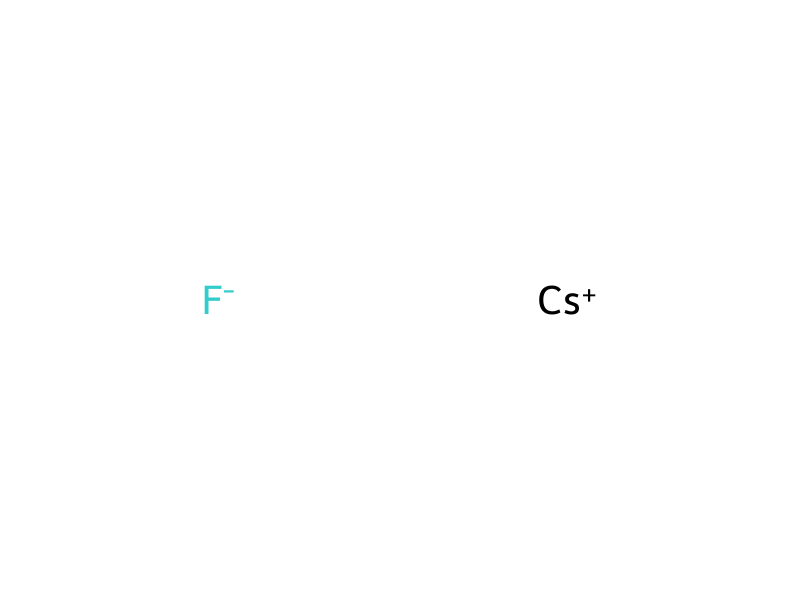
HCID 25953Cesium fluorideHCID 573521422,7-Dibromo-1,8-naphthyridineHCID 71285691Diethyl 5-(4,4,5,5-tetramethyl-1,3,2-dioxaborolan-2-yl)isophthalate

Product 1

HCID 117940372Tetraethyl 5,5'-(1,8-naphthyridine-2,7-diyl)diisophthalateYield 70%

Reagents, catalysts & solvents 1

HCID 178418397
HCID 178418397, compound
Catalyst

Procedure

To a 250 mL Schlenk flask, 2,7-dibromo-1,8-naphthyridine (2.00 g, 6.94 mmol), diethyl 5-(4,4,5,5-tetramethyl-1,3,2-dioxaborolan-2-yl)isophthalate (6.06 g, 17.40 mmol, this compound was synthesized according to literature method: J. Natera, L. Otero, L. Sereno, F. Fungo, N.-S. Wang, Y.-M. Tsai, T.-Y. Hwu, K.-T. Wong, Macromolecules 2007, 40, 4456-4463), CsF (4.00 g) and Pd(PPh3)4 (200 mg) were added. The flask was connected to a Schlenk line and evacuated of air then refilled with nitrogen. 140 mL of 1,2-dimethoxyethane (DME) was degassed (two hours) and added to the flask through a canula. The flask was equipped with a water condenser and refluxed under nitrogen for 3 days. The solvent was removed on a rotary evaporator. 100 mL of H2O was added and then extracted with CHCl3. The organic phase was dried with MgSO4. After removal of the CHCl3 solvent, the crude product was purified by column chromatography (silica, ethyl acetate/hexane, 20% and then 50%) to give a yellow solid product with a yield of 70% (2.77 g) based on 2,7-dibromo-1,8-naphthyridine. 1H NMR (300 MHz, DMSO-d6): δ 1.42 (t, 12H), 4.46 (q, 8H), 8.43 (d, 2H), 8.60 (s, 2H), 8.69 (d, 2H), 9.07 (s, 4H).

Workup

  1. customThe flask was connected to a Schlenk
  2. customline and evacuated of air
  3. additionthen refilled with nitrogen
  4. custom140 mL of 1,2-dimethoxyethane (DME) was degassed (two hours)
  5. additionadded to the flask through a canula
  6. customThe flask was equipped with a water condenser
  7. temperaturerefluxed under nitrogen for 3 days
  8. customThe solvent was removed on a rotary evaporator
  9. addition100 mL of H2O was added
  10. extractionextracted with CHCl3
  11. dry with materialThe organic phase was dried with MgSO4
  12. customAfter removal of the CHCl3 solvent
  13. customthe crude product was purified by column chromatography (silica, ethyl acetate/hexane, 20%
  14. custom50%) to give a yellow solid product with a yield of 70% (2.77 g)

Sources & evidence

ORD record
ord-eaa4932a1b434b09a4b7322ae9b21e44
Source dataset
uspto-grants-2016_08
DOI
10.6084/m9.figshare.5104873.v1
Patent number
US09421514B2

Reaction notes

On this pageParticipantsProcedureWorkupSources & evidenceReaction notes