Methanol → Esflurbiprofen
HRID 1489393
Reaction equation

[CH3:1][CH:2]([C:16]([OH:18])=[O:17])[C:3]1[CH:4]=[CH:5][C:6]([C:10]2[CH:11]=[CH:12][CH:13]=[CH:14][CH:15]=2)=[C:7]([F:9])[CH:8]=1.CO.S(=O)(=O)(O)O>C(OCC)(=O)C.O>[CH3:1][C@H:2]([C:16]([OH:18])=[O:17])[C:3]1[CH:4]=[CH:5][C:6]([C:10]2[CH:11]=[CH:12][CH:13]=[CH:14][CH:15]=2)=[C:7]([F:9])[CH:8]=1Participants
5
Reactant 3


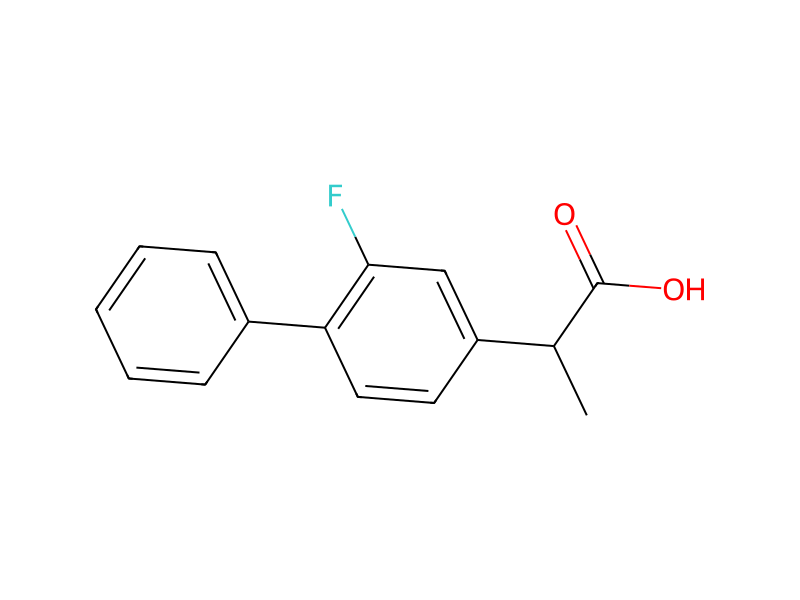
Product 1

Reagents, catalysts & solvents 1

Procedure
A sample of 6.2 g (25 mmol) of R,S flurbiprofen was combined with 40 g of methanol and stirred until dissolved. The solution was treated with 3.14 g (21 mmol) of cis (1R,2S)-1-aminoindan-2-ol, seeded with a small amount of (1R,2S)-1-aminoindan-2-ol (S)-flurbiprofen diastereomer, and allowed to crystallize over a period of 17 hours at ambient temperature. The mixture was then cooled and held at 4° C. for 5 hours. The solids were isolated by filtration, washed with 35 mL methanol, and dried to afford 3.8 g (38M % yield) of white crystals. The acid was released by dissolving the solid in 200 mL of an ethyl acetate-water (50/50; v/v) mixture and treating the solution with 3 g of 5N aqueous sulfuric acid. After mixing, the aqueous phase was decanted and the organic phase washed twice with 100 mL of water. The organic phase was then evaporated under vacuum. The weight of the solid residue was 2.1 g. The rotation [α]D of this solid was -18.8 (c=1, ethanol) corresponding to (S)-flurbiprofen of 44.6% enantiomeric excess.