Reaction equation
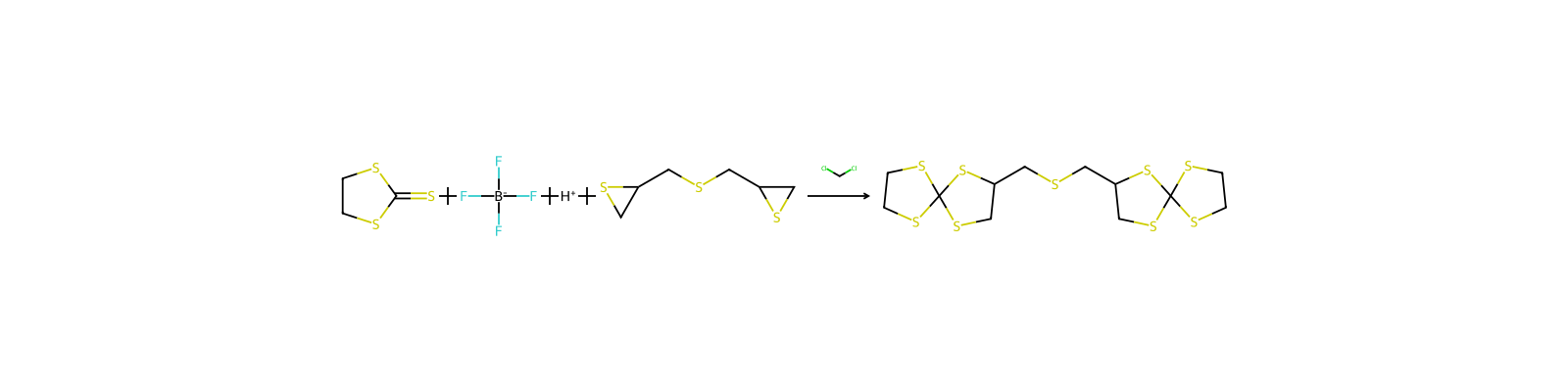
[C:1]1(=[S:6])[S:5][CH2:4][CH2:3][S:2]1.F[B-](F)(F)F.[H+].[S:13]([CH2:18][CH:19]1[CH2:21][S:20]1)[CH2:14][CH:15]1[CH2:17][S:16]1>ClCCl>[S:13]([CH2:14][CH:15]1[CH2:17][S:16][C:1]2([S:5][CH2:4][CH2:3][S:2]2)[S:6]1)[CH2:18][CH:19]1[CH2:21][S:20][C:1]2([S:5][CH2:4][CH2:3][S:2]2)[S:6]1Participants
5




Conditions
- Temperature
- -5 °C
Procedure
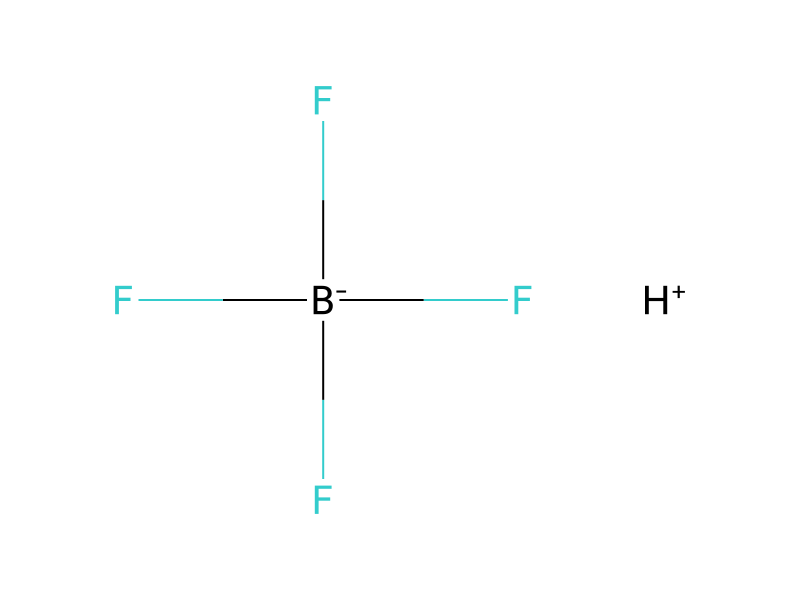
A mixture of ethylene trithiocarbonate (5.04 g, 0.037 moles) and tetrafluoroboric acid (1.0 ml) in anhydrous dichloromethane (50.0 ml) cooled to −5° C. and stirred under nitrogen, was treated dropwise with a solution of 2,2′-[thiobis(methylene)]bis-thiirane (3.34 g, 0.019 moles) in anhydrous dichloromethane (30.0 ml). The resulting mire was allowed to warm to room temperature and quenched with 5% sodium bicarbonate solution (50.0 ml). The separation of the organic layer followed by water washing, drying and evaporation afford a wet yellow solid. Purification of which by short-path chromatography (20% ethyl acetate/hexane over silica) afforded 2,2′-[thiobis(methylene)]bis-1,4,6,9-tetrathiaspiro[4.4]nonane (4.7% yield).
Workup
- temperatureto warm to room temperature
- customquenched with 5% sodium bicarbonate solution (50.0 ml)
- customThe separation of the organic layer
- customdrying
- customevaporation
- customafford a wet yellow solid
- customPurification of which by short-path chromatography (20% ethyl acetate/hexane over silica)
Sources & evidence
- ORD record
- ord-d26563509c44439d949701404d266712
- Source dataset
- uspto-grants-2010_06
- Patent number
- US07732507B2
Linked notes
Loading…