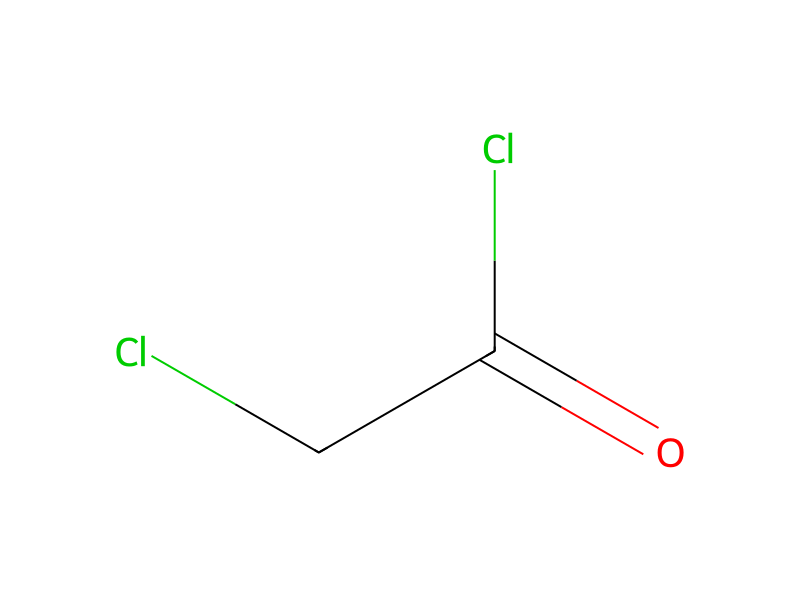
Chloroacetyl chloride → Chloroac-Tyr-Oet
HRID 1531469
Reaction equation

NCC(N[C@H](C(O)=O)CC1C=CC(O)=CC=1)=O.[CH2:18]([O:20][C:21](=[O:32])[C@H:22]([CH2:24][C:25]1[CH:30]=[CH:29][C:28]([OH:31])=[CH:27][CH:26]=1)[NH2:23])[CH3:19].[Cl:33][CH2:34][C:35](Cl)=[O:36]>>[CH2:18]([O:20][C:21](=[O:32])[C@H:22]([CH2:24][C:25]1[CH:26]=[CH:27][C:28]([OH:31])=[CH:29][CH:30]=1)[NH:23][C:35](=[O:36])[CH2:34][Cl:33])[CH3:19]Participants
4


Procedure
A process for producing N-glycyl-L-tyrosine is disclosed in Berichte der Deutschen Chemischen Gesellschaft, p. 2486 (1904). In the process, L-tyrosine is subjected to a reaction with 1.1 equivalents of chloroacetyl chloride and an aqueous solution of sodium hydroxide to obtain N-chloroacetyl-L-tyrosine, which is then made to react with aqueous ammonia to prepare N-glycyl-L-tyrosine. This process gives N-chloroacetyl-L-tyrosine, which is an intermediate for the synthesis of N-glycyl-L-tyrosine, in a 50% yield. The above literature also discloses a process in which L-tyrosine ethyl ester is made to react with 1.0 equivalent of chloroacetyl chloride to form N-chloroacetyl-L-tyrosine ethyl ester, which is then hydrolyzed to prepare N-chloroacetyl-L-tyrosine. In this process, the overall yield of N-chloroacetyl-L-tyrosine based on L-tyrosine ethyl ester is 91%, and that based on L-tyrosine is 77% as the yield in the step of conversion into ethyl ester from L-tyrosine is 85%. The process for producing N-glycyl-L-tyrosine via L-tyrosine ethyl ester is thus advantageous in respect of yield over the process in which L-tyrosine is directly chloroacetylated. However, when applied to the production on an industrial scale, the former process which requires the steps of esterification and hydrolysis is inefficient compared with the latter process requiring a smaller number of steps.