Ethyl 4,4,4-trifluoroacetoacetate → Ethyl 3-(N,N-dimethylamino)acrylate
HRID 1533430
Reaction equation

FC(F)(F)C([C:5](=[CH:11][N:12]([CH3:14])[CH3:13])[C:6]([O:8][CH2:9][CH3:10])=[O:7])=O.FC(F)(F)C(=O)CC(OCC)=O>C(O)(=O)C>[CH3:13][N:12]([CH:11]=[CH:5][C:6]([O:8][CH2:9][CH3:10])=[O:7])[CH3:14]Participants
4


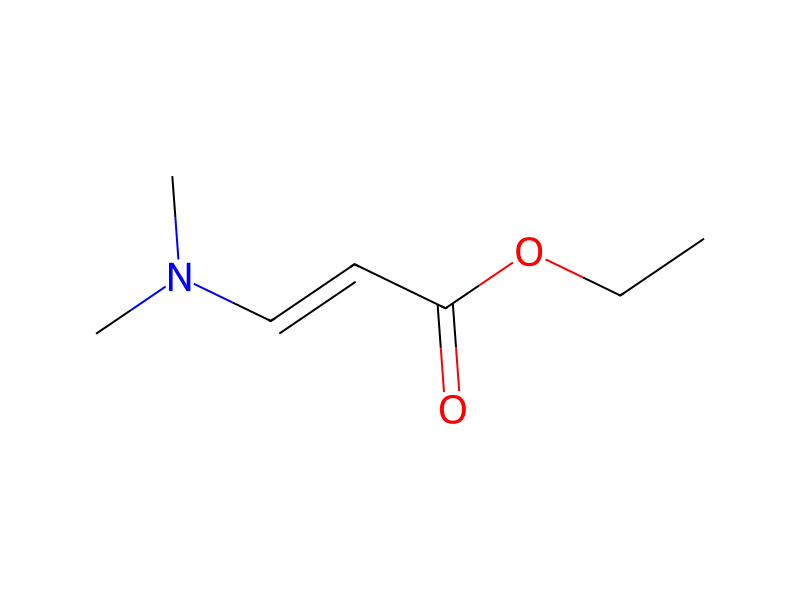

Procedure
I have found surprisingly conditions which allow the preparation of ethyl 2-trifluoroacetyl-3-(N,N-dimethylamino)-2-propenoate (2) from ethyl trifluoroacetoacetate and DMF acetals according to a general one-step reaction. Specifically, I found that compound 2 can be prepared in good yields (61-85%) by reacting ethyl trifluoroacetoacetate with DMF acetals in the presence of an organic acid such as acetic acid. While not wishing to be bound by theory, the success of this reaction condition appears to lie in the suppression of the loss of the trifluoroacetyl group from (2) through the attack of the alcohol by-products. In the absence of the organic acid, ethyl 3-(N,N-dimethylamino)-2-propenoate (4) is formed as the major product in all cases. My overall result is shown in Scheme 2.