HuagongsheHuagongshe Chemistry Print Report · For research reference only
HRID 155Generated: October 23, 2026
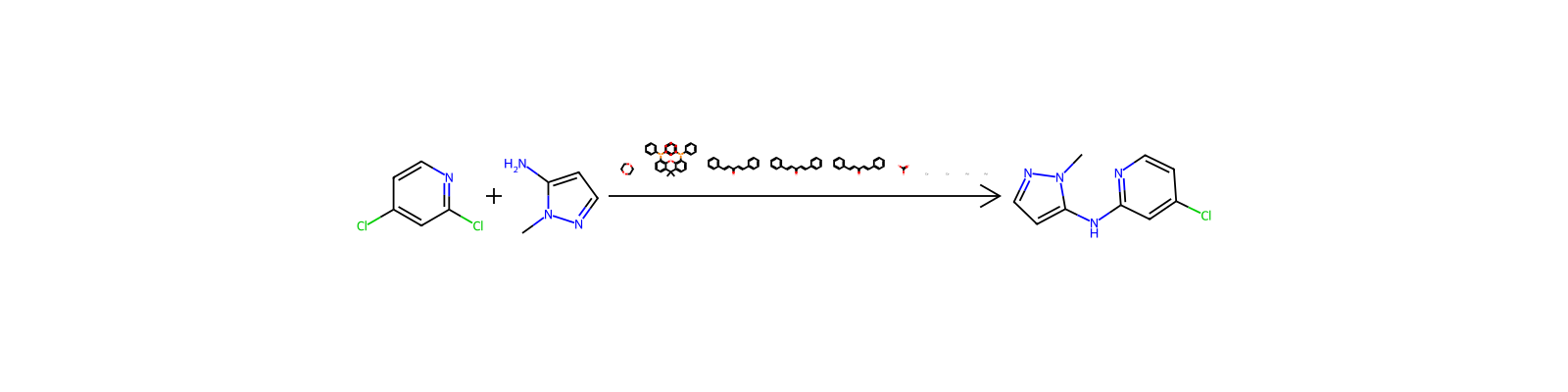
2,4-Dichloropyridine → 4-chloro-N-(2-methylpyrazol-3-yl)pyridin-2-amine
https://huagongshe.com/en/reaction/155
Participants
| Role | Name | HCID | Charge |
|---|
| Reactant | 2,4-Dichloropyridine | HCID 33515 | — |
| Reactant | 2-Methyl-2H-pyrazol-3-ylamine | HCID 136927 | — |
| Reagent | Cesium carbonate | HCID 10796 | — |
| Catalyst | 1,1'-(9,9-Dimethyl-9H-xanthene-4,5-diyl)bis(1,1-diphenylphosphine) | HCID 636044 | — |
| Catalyst | Bis(dibenzylideneacetone)palladium | HCID 9811564 | — |
| Solvent | 1,4-Dioxane | HCID 31275 | — |
| Product | 4-chloro-N-(2-methylpyrazol-3-yl)pyridin-2-amine | HCID 121439713 | 20.66% |
Reaction Steps
TRIS(DIBENZYLIDENEACETONE)DIPALLADIUM(0) (1.238 g, 1.35 mmol) was added in one portion to 2,4-dichloropyridine (10g, 67.57 mmol), 1-methyl-1H-pyrazol-5-amine (7.22 g, 74.33 mmol), (9,9-dimethyl-9H-xanthene-4,5-diyl)bis(diphenylphosphine) (2.346 g, 4.05 mmol) and cesium carbonate (33.0 g, 101.36 mmol) in 1,4-dioxane (350 mL) warmed to 105ºC over a period of 20 hours under nitrogen. The reaction mixture was evaporated to dryness and redissolved in DCM (250 mL), and washed with water (200 mL) The organic layer was filtered using phase separating paper and evaporated to afford crude product. The crude product was purified by flash silica chromatography, elution gradient 0 to 3% MeOH in DCM. Relavent fractions were repurified by flash silica chromatography, elution gradient 0 to 5% MeOH in EtOAc. Pure fractions were evaporated to dryness to afford 4-chloro-N-(1-methyl-1H-pyrazol-5-yl)pyridin-2-amine (2.91 g, 20.66 %) as a yellow crystalline solid.
Provenance & Evidence
| Source dataset | 750 AstraZeneca ELN dataset |
|---|
| ORD ID | ord-0394a7894466450da1ab8d7f700166f5 |
|---|
| Source note | 750 AstraZeneca ELN dataset |
|---|