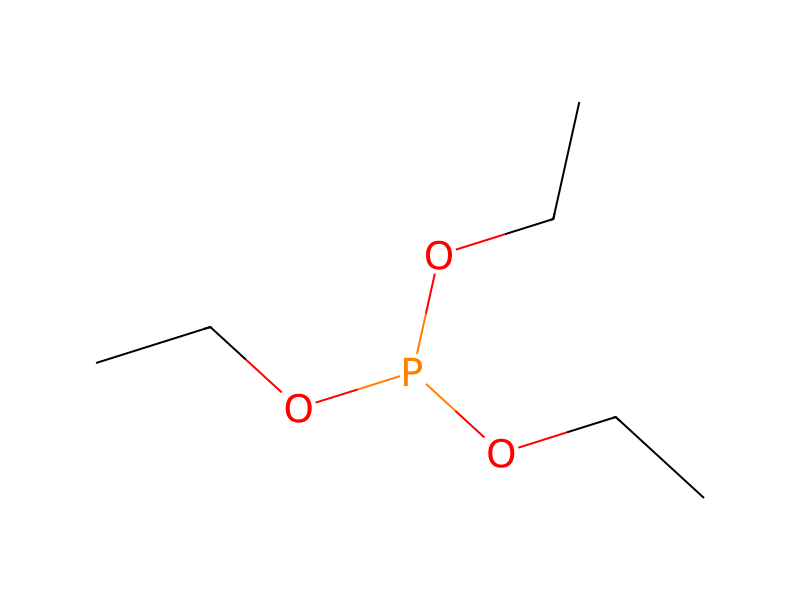
Triethyl phosphite → Diethylphosphonoacetylurea
HRID 1578464
Reaction equation

Cl[CH2:2][C:3]([NH:5][C:6]([NH2:8])=[O:7])=[O:4].[P:9]([O:16]CC)([O:13][CH2:14][CH3:15])[O:10][CH2:11][CH3:12]>>[CH2:11]([O:10][P:9]([CH2:2][C:3]([NH:5][C:6]([NH2:8])=[O:7])=[O:4])([O:13][CH2:14][CH3:15])=[O:16])[CH3:12]Participants
3


Procedure
While stirring, 682 gm (5 mol) of chloroacetylurea were added portionwise to 831 gm (5 mol) of triethyl phosphite at a temperature of 135°C to 150°C. Each time, the addition of the next portion was delayed until the violent gas evolution had abated. After the last portion of chloracetylurea had been added, the stirring was continued at 150°C until the evolution of gas was terminated. Small quantities of a volatile substance distilled off when the reaction mixture was heated on the water bath under the vacuum generated by an oil pump. The reaction mixture solidified upon cooling. The pure diethylphosphonoacetylurea was obtained from the crude product by recrystallization from isopropanol or acetone and proved to be a water-soluble product having a melting point of 120°C. The yield of crude product was 1120 gm (94% of the theory).