Reaction equation
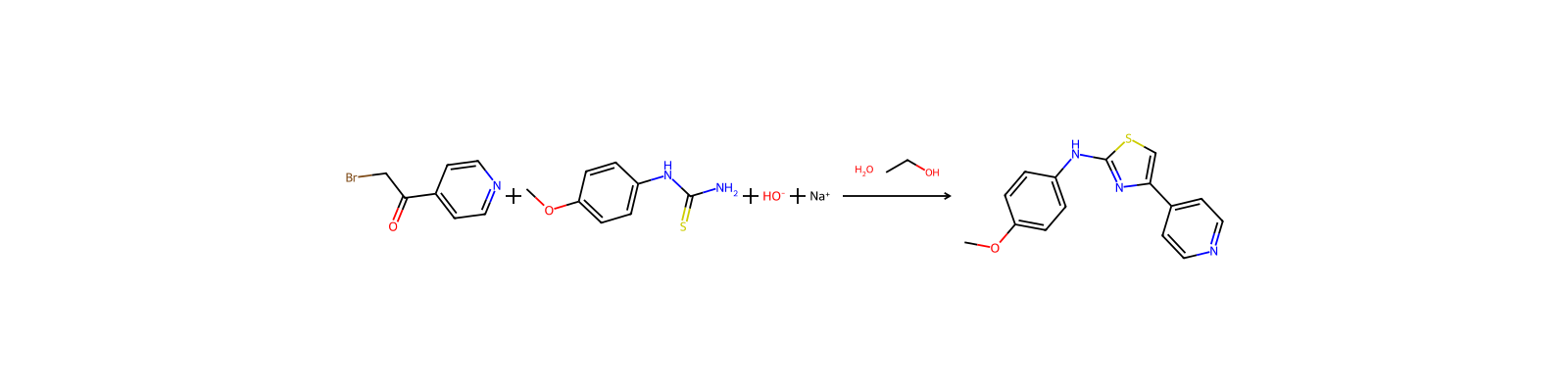
Br[CH2:2][C:3]([C:5]1[CH:10]=[CH:9][N:8]=[CH:7][CH:6]=1)=O.[CH3:11][O:12][C:13]1[CH:18]=[CH:17][C:16]([NH:19][C:20]([NH2:22])=[S:21])=[CH:15][CH:14]=1.[OH-].[Na+]>O.CCO>[CH3:11][O:12][C:13]1[CH:14]=[CH:15][C:16]([NH:19][C:20]2[S:21][CH:2]=[C:3]([C:5]3[CH:10]=[CH:9][N:8]=[CH:7][CH:6]=3)[N:22]=2)=[CH:17][CH:18]=1Participants





Procedure
To a solution of 3.0 g (15 mmol) 4-(2-bromo)acetylpyridine (6-2) in 50 mL water was added an equimolar amount of 4-methoxyphenylthiourea (7-1; 2.75 g). The reaction was diluted with 20 mL EtOH. The reaction was allowed to stir at rt overnight, over which time a color change occurred from clear to a thick orange precipitate. The reaction mixture was diluted with 100 mL water then the pH was adjusted to neutral with 1N NaOH. The reaction was allowed to stir at rt and a large amount of precipitate formed which was collected by filtration. The resulting powder was dried under high vacuum to yield N-(4-methoxyphenyl)-4-pyridin-4-yl-1,3-thiazol-2-amine (7-2): 1H NMR (500 MHz, CD3OD) δ 8.98 (d, J=3 Hz, 2H), 8.10 (d, J=3 Hz, 2H), 7.53 (s, 1H), 3.0 (s, 3H): MS 284.3 found 284.2 (M+H+).
Workup
- stirringto stir at rt
- customa large amount of precipitate formed which
- filtrationwas collected by filtration
- customThe resulting powder was dried under high vacuum
Sources & evidence
- ORD record
- ord-a5e9366d433941d3b9570efba81fe766
- Source dataset
- uspto-grants-2007_11
- Patent number
- US07294640B2
Linked notes
Loading…