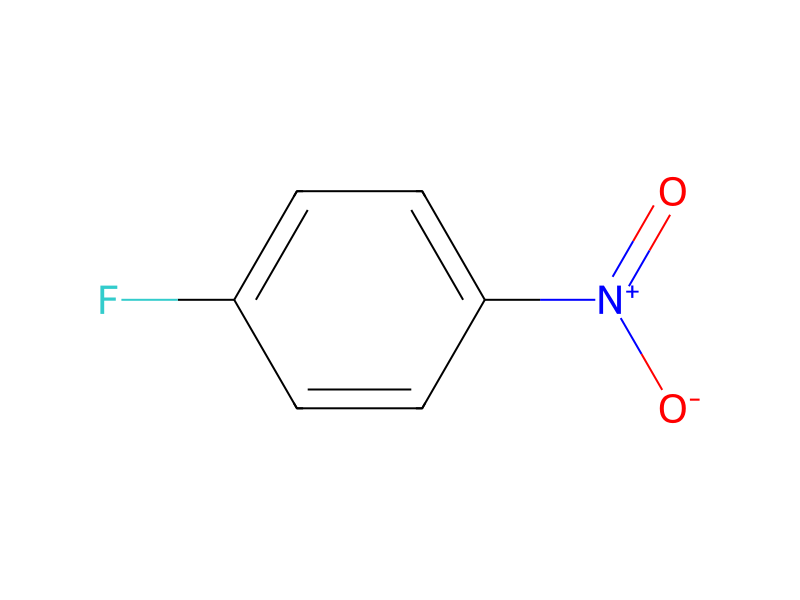
[C:1]1([C:7]2[CH:11]=[C:10]([CH2:12][CH3:13])[NH:9][N:8]=2)[CH:6]=[CH:5][CH:4]=[CH:3][CH:2]=1.CC(C)([O-])C.[K+].F[C:21]1[CH:26]=[CH:25][C:24]([N+:27]([O-:29])=[O:28])=[CH:23][CH:22]=1>CS(C)=O>[N+:27]([C:24]1[CH:25]=[CH:26][C:21]([N:9]2[C:10]([CH2:12][CH3:13])=[CH:11][C:7]([C:1]3[CH:2]=[CH:3][CH:4]=[CH:5][CH:6]=3)=[N:8]2)=[CH:22][CH:23]=1)([O-:29])=[O:28]To a solution of 3-phenyl-5-ethylpyrazole (1.0 g, 5.8 mmol) in DMSO (5 mL) was added potassium t-butoxide (0.72 g, 6.4 mmol) followed by 4-fluoronitrobenzene (0.65 mL, 6.4 mmol). The mixture was heated at 90° C. for 1 hour, cooled to rt, and quenched with water (50 mL). The precipitate was collected by filtration, redissolved in ethyl acetate (50 mL), treated with active carbon (3 g), and filtered through diatomaceous earth. The mixture was concentrated to 5 mL, and hexane (25 mL) was added. The 1-(4′-nitrophenyl)-3-phenyl-5-ethylpyrazole was collected by filtration (1.70 g, 92%): mp 112-113° C. NMR 8.39 (2H, d), 7.79 (2H, d), 7.90 (2H, m), 7.45 (2H, m), 7.38 (1H, m), 6.66 (1H, s), 2.86 (2H, q), 1.38 (3H, t).
Loading…