Reaction equation

[C:1]([C:4]1[N:5]=[CH:6][C:7]2[C:12]([CH:13]=1)=[CH:11][CH:10]=[CH:9][CH:8]=2)(=[O:3])[CH3:2].[BH4-].[Na+]>CO>[OH:3][CH:1]([C:4]1[N:5]=[CH:6][C:7]2[C:12]([CH:13]=1)=[CH:11][CH:10]=[CH:9][CH:8]=2)[CH3:2]Participants
Reactant 2

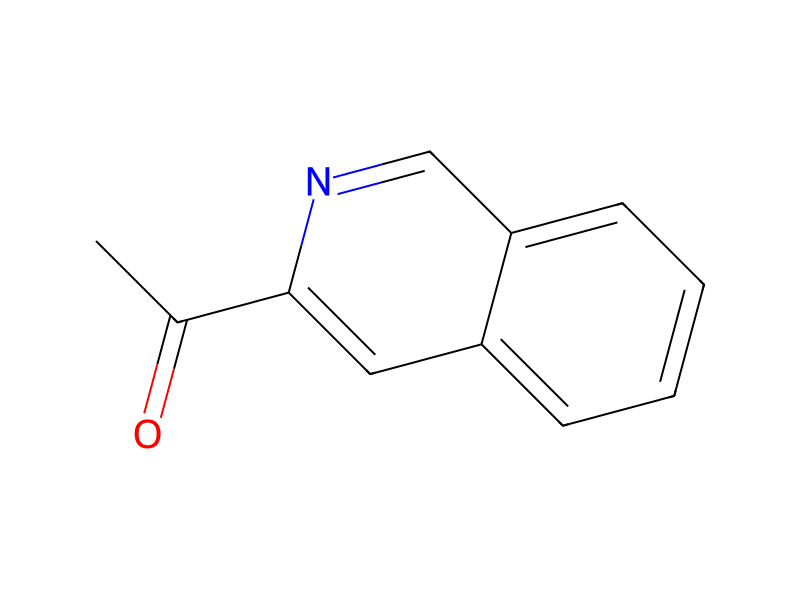
Product 1

Reagents, catalysts & solvents 1

Conditions
- Temperature
- 0 °C
Procedure
3-Acetyl-isoquinoline (1.53 g, 8.9 mmole) is dissolved in 42 ml methanol in a 100 ml one neck round bottom flask at 0° C. The solution is treated portionwise with sodium borohydride (388 mg, 10.3 mmole) and the reaction mixture is stirred 30 min at 0° C. The volatiles are removed in vacuo and the residue is partitioned between 1×100 ml 1N sodium hydroxide and 3×25 ml dichloromethane. The combined organics are dried over potassium carbonate and are concentrated in vacuo to a pale yellow solid. The crude material is chromatographed over 60 g silica gel (230-400 mesh), eluting with 40% acetone/hexane, while collecting 9 ml fractions. Fractions 26-45 are combined and concentrated to afford 1.23 g (80%) of 3-(1-hydroxyethyl)-isoquinoline.
Workup
- customThe volatiles are removed in vacuo
- customthe residue is partitioned between 1×100 ml 1N sodium hydroxide and 3×25 ml dichloromethane
- dry with materialThe combined organics are dried over potassium carbonate
- concentrationare concentrated in vacuo to a pale yellow solid
- customThe crude material is chromatographed over 60 g silica gel (230-400 mesh)
- washeluting with 40% acetone/hexane
- customwhile collecting 9 ml fractions
- concentrationconcentrated
Sources & evidence
- ORD record
- ord-55e7e01a2262485a807e4d02438b7ea1
- Source dataset
- uspto-grants-2000_03
- Patent number
- US06043248
Linked notes
Loading…