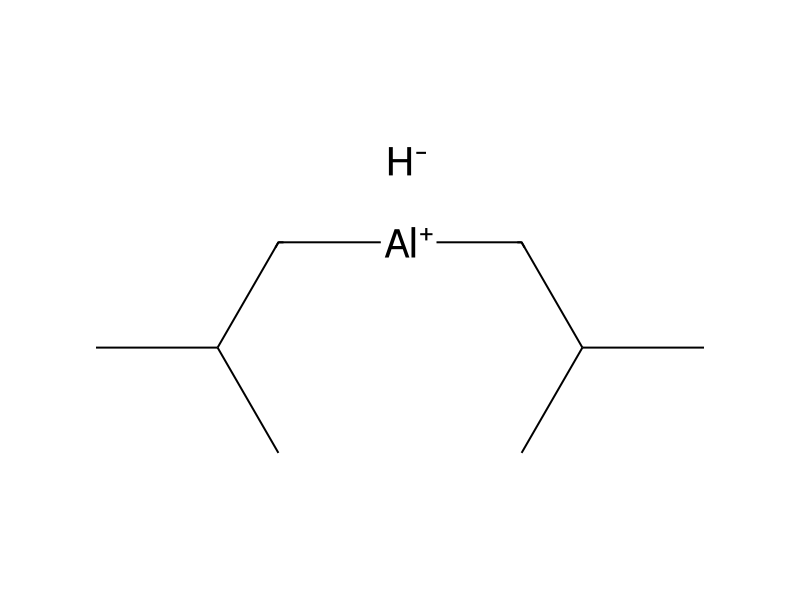
[Cl:1][C:2]1[C:11]([C:12](OCC)=[O:13])=[C:10]([C:17]2[CH:22]=[CH:21][C:20]([F:23])=[CH:19][CH:18]=2)[C:9]2[C:4](=[CH:5][CH:6]=[CH:7][CH:8]=2)[N:3]=1.[H-].C([Al+]CC(C)C)C(C)C>ClCCl>[Cl:1][C:2]1[C:11]([CH2:12][OH:13])=[C:10]([C:17]2[CH:18]=[CH:19][C:20]([F:23])=[CH:21][CH:22]=2)[C:9]2[C:4](=[CH:5][CH:6]=[CH:7][CH:8]=2)[N:3]=1Ethyl 2-chloro-4-(4-fluorophenyl)-3-quinolinecarboxylate (12.91 g) is dissolved in 200 ml of dichloromethane at -78° C. under an atmosphere of nitrogen. A solution of diisobutylaluminum hydride (DIBAL) (97 ml, 2.5 equivalents) in dichloromethane is added dropwise and the reaction stirred for 3.5 hours at -78° C. The reaction is quenched by addition of a saturated solution of sodium sulfate (20 ml) and removing the cooling bath. The gelatinous mass is filtered through Celite, washed with hot ethyl acetate, and the filtrate evaporated to give 9.36 g of 2-chloro-4-(4-fluorophenyl)-3-quinolinemethanol as a white solid; mp 159°-160° C.; 1H NMR (chloroform-d): δ 8.07 (d, 1H), 7.79-7.70 (m, 1H), 7.53-7.22 (m, 6H), 4.67 (d, 2H), 2.24 (t, 1H) ppm.