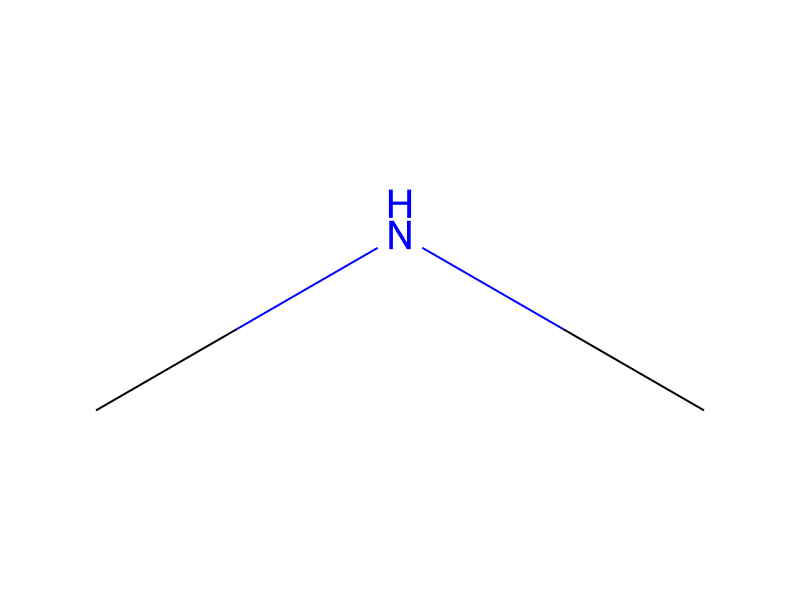
Dimethylamine → 2-(Dimethylamino)-4-(4-fluorophenyl)-3-quinolinecarboxaldehyde
HRID 1650137
Reaction equation

Cl[C:2]1[C:11]([CH:12]=[O:13])=[C:10]([C:14]2[CH:19]=[CH:18][C:17]([F:20])=[CH:16][CH:15]=2)[C:9]2[C:4](=[CH:5][CH:6]=[CH:7][CH:8]=2)[N:3]=1.[CH3:21][NH:22][CH3:23]>C1(C)C=CC=CC=1>[CH3:21][N:22]([CH3:23])[C:2]1[C:11]([CH:12]=[O:13])=[C:10]([C:14]2[CH:19]=[CH:18][C:17]([F:20])=[CH:16][CH:15]=2)[C:9]2[C:4](=[CH:5][CH:6]=[CH:7][CH:8]=2)[N:3]=1Participants
4
Reactant 2

Product 1

Reagents, catalysts & solvents 1

Procedure
2-Chloro-4-(4-fluorophenyl)-3-quinolinecarboxaldehyde (5.28 g) and 15 ml of dimethylamine are dissolved in 75 ml of toluene. This mixture is autoclaved for 14 hours at 123°-136° C. The mixture is cooled, evaporated to dryness, and partitioned between ethyl acetate and a saturated aqueous solution of potassium carbonate. The ethyl acetate layer is dried (magnesium sulfate) and evaporated to give an orange oil. Chromatography (silica, 10% ethyl acetate/hexanes) gives 4.20 g of 2-(dimethylamino)-4-(4-fluorophenyl)-3-quinolinecarboxaldehyde as an orange solid; 1H NMR (chloroform-d): δ 9.73 (s, 1H), 7.78-6.96 (m, 8H), 3.10 (s, 6H) ppm.