Reaction equation
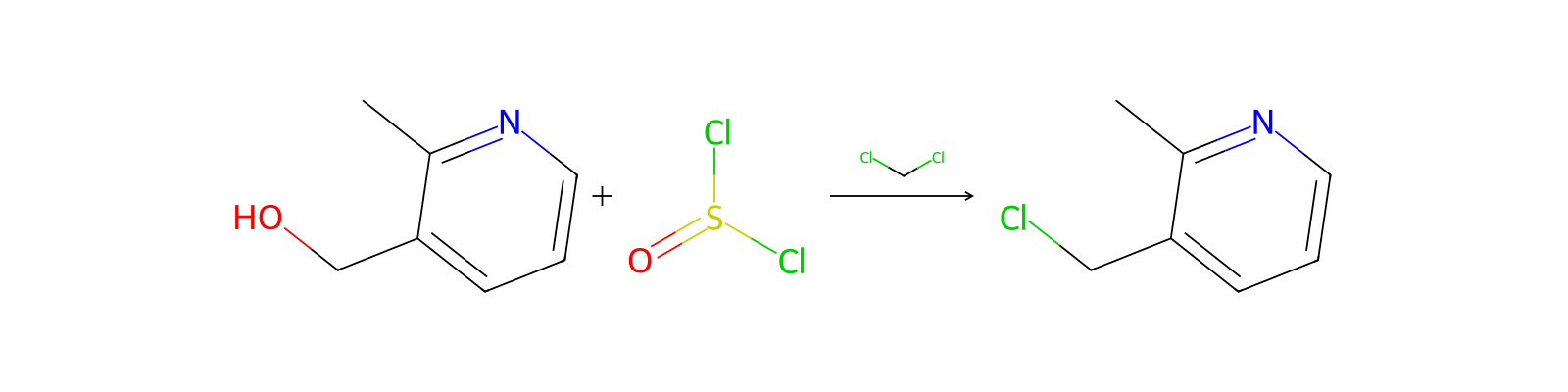
O[CH2:2][C:3]1[C:4]([CH3:9])=[N:5][CH:6]=[CH:7][CH:8]=1.O=S(Cl)[Cl:12]>C(Cl)Cl>[Cl:12][CH2:2][C:3]1[C:4]([CH3:9])=[N:5][CH:6]=[CH:7][CH:8]=1Participants
4
Reactant 2


Product 1

Reagents, catalysts & solvents 1

Procedure
To a stirred solution of 3-hydroxymethyl-2-methylpyridine from Step 1 above (1.00 g, 8.13 mmol) in 40 mL of CH2Cl2 at ambient temperature was added SOCl2 (9.0 mL, 123 mmol). The reaction mixture was stirred for 4 hours, and the solvent and excess SOCl2 were evaporated under reduced pressure. The residue was partitioned between CH2Cl2 and saturated aqueous NaHCO3. The organic layer was separated, and the aqueous layer was washed with additional CH2 Cl2 (2×40 mL). The combined organic layers were evaporated under reduced pressure to give 3-chloromethyl-2-methylpyridine as a pale yellow-brown solid (TLC: Rf =0.85 in 5% MeOH in CH2Cl2 ; FAB MS m/z 142 (M+ +H)).
Workup
- customthe solvent and excess SOCl2 were evaporated under reduced pressure
- customThe residue was partitioned between CH2Cl2 and saturated aqueous NaHCO3
- customThe organic layer was separated
- washthe aqueous layer was washed with additional CH2 Cl2 (2×40 mL)
- customThe combined organic layers were evaporated under reduced pressure
Sources & evidence
- ORD record
- ord-b03b7005ae0f4e16a4358a35620a3d77
- Source dataset
- uspto-grants-1998_03
- Patent number
- US05726172
Linked notes
Loading…