Reaction equation
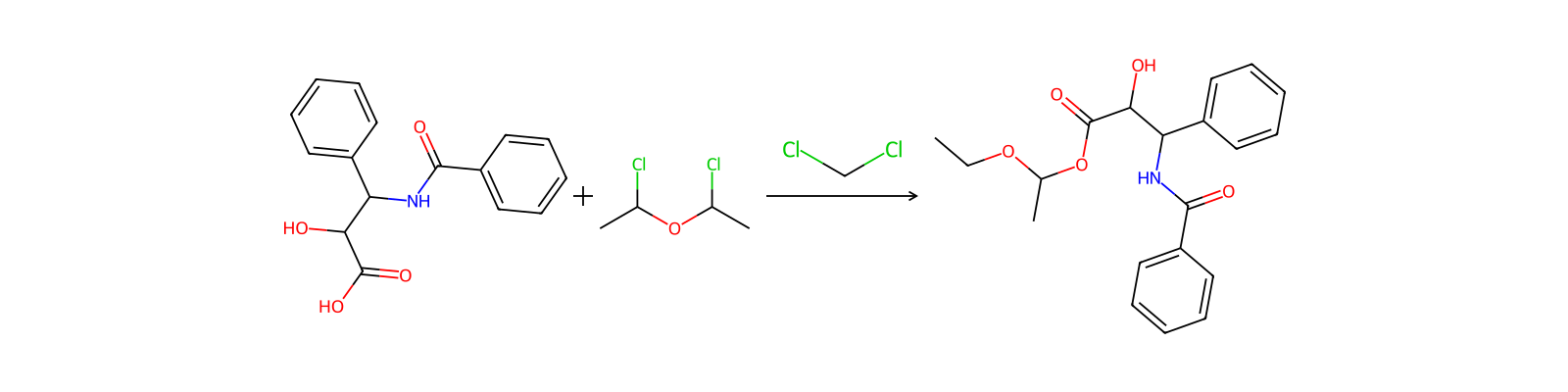
[C:1]([NH:9][CH:10]([C:16]1[CH:21]=[CH:20][CH:19]=[CH:18][CH:17]=1)[CH:11]([C:13]([OH:15])=[O:14])[OH:12])(=[O:8])[C:2]1[CH:7]=[CH:6][CH:5]=[CH:4][CH:3]=1.Cl[CH:23]([O:25][CH:26](Cl)[CH3:27])[CH3:24]>C(Cl)Cl>[C:1]([NH:9][CH:10]([C:16]1[CH:21]=[CH:20][CH:19]=[CH:18][CH:17]=1)[CH:11]([C:13]([O:15][CH:23]([O:25][CH2:26][CH3:27])[CH3:24])=[O:14])[OH:12])(=[O:8])[C:2]1[CH:3]=[CH:4][CH:5]=[CH:6][CH:7]=1Participants
4
Reactant 2


Product 1

Reagents, catalysts & solvents 1

Procedure
The epoxide of the cis-cinnamate is then regioselectively opened to produce 3-phenyl isoserinamide. This 3-phenyl isoserinamide is hydrolyzed to produce 3-phenyl-isoserine, which in turn is reacted with benzoyl chloride to form N-benzoyl-3-phenyl-isoserine. Next, the N-benzoyl-3-phenyl-isoserine is reacted with 1-chloroethyl ether and a tertiary amine in methylene chloride to form N-benzoyl-O-(1-ethoxyethyl)-3-phenyl-isoserine. Then, N-benzoyl-O-(1-ethoxyethyl)-3-phenyl-isoserine is reacted with the alcohol shown below: ##STR8## This resulting intermediate is converted to taxol by hydrolytically removing the 1-ethoxyethyl and triethylsilyl protecting groups.
Sources & evidence
- ORD record
- ord-1d4ba00281db40afa6d9a95837f9755f
- Source dataset
- uspto-grants-1997_06
- Patent number
- US05637739
Linked notes
Loading…