HomeMCPWorkbenchSkills
HomeWorkbenchNotificationsMe
llms.txt · MCP GuidePrivacy Policy · Terms of Service · Supportv1.8.3
  1. Home
  2. /Reaction

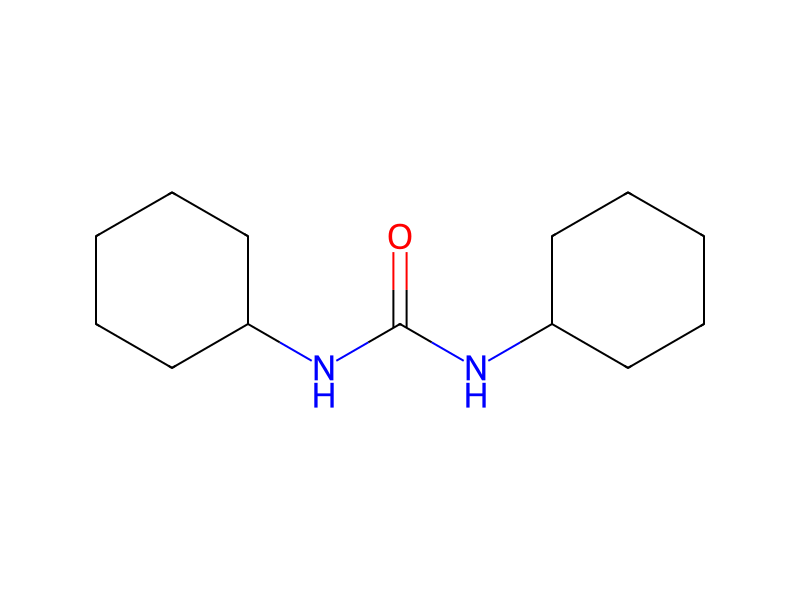
Dicyclohexylcarbodiimide → N,N'-Dicyclohexylurea

HRID 1704793
Print

Reaction equation

HRID 1704793 reaction equation
C(O)[C@@H](O)C(O)=[O:4].NC1C=CC(C=C)=CC=1.[CH:17]1([N:23]=[C:24]=[N:25][CH:26]2[CH2:31][CH2:30][CH2:29][CH2:28][CH2:27]2)[CH2:22][CH2:21][CH2:20][CH2:19][CH2:18]1.NC=CC1C=CC=CC=1>C(#N)C>[CH:26]1([NH:25][C:24]([NH:23][CH:17]2[CH2:18][CH2:19][CH2:20][CH2:21][CH2:22]2)=[O:4])[CH2:31][CH2:30][CH2:29][CH2:28][CH2:27]1
ParticipantsProcedureSources & evidenceReaction notes

Participants

6

Reactant 4

HCID 10868Dicyclohexylcarbodiimide2×HCID 737004-AminostyreneHCID 155076Ethenamine, 2-phenyl-HCID 439194(2R)-2,3-Dihydroxypropanoic acid3×

Product 1

HCID 4277N,N'-Dicyclohexylurea

Reagents, catalysts & solvents 1

HCID 6342
Acetonitrile
Solvent

Procedure

Alternatively D-glyceric acid -(p-vinylanilide) can be prepared directly from D-glyceric acid and p-aminostyrene on treatment with N,N'-dicyclohexylcarbodiimide as condensing agent: To a solution (cooled to 0° C) of 5.3 g (0.05 mole) D-glyceric acid in 150 ml of acetonitrile, there was added 8.9 g (0.075 mole) β aminostyrene and 10.3 g (0.05 mole) N.N'-dicyclohexylcarbodiimide. A precipitate of N.N'-dicyclohexylurea is formed immediately, but the reaction was allowed to proceed for 15 hours at room temperature. After filtration and removal of the acetonitrile by distillation under reduced pressure, the residue was taken up in ethyl acetate and extracted with HCl, bicarbonate and water. After drying and removal of the solvent the residue was crystallized from chloroform, yielding 7.5 g (73%), m.p. 135 - 136° C.

Sources & evidence

ORD record
ord-7713d8c3e4494ccb8173fcbabb5756ab
Source dataset
uspto-grants-1978_11
DOI
10.6084/m9.figshare.5104873.v1
Patent number
US04127730

Reaction notes

On this pageParticipantsProcedureSources & evidenceReaction notes