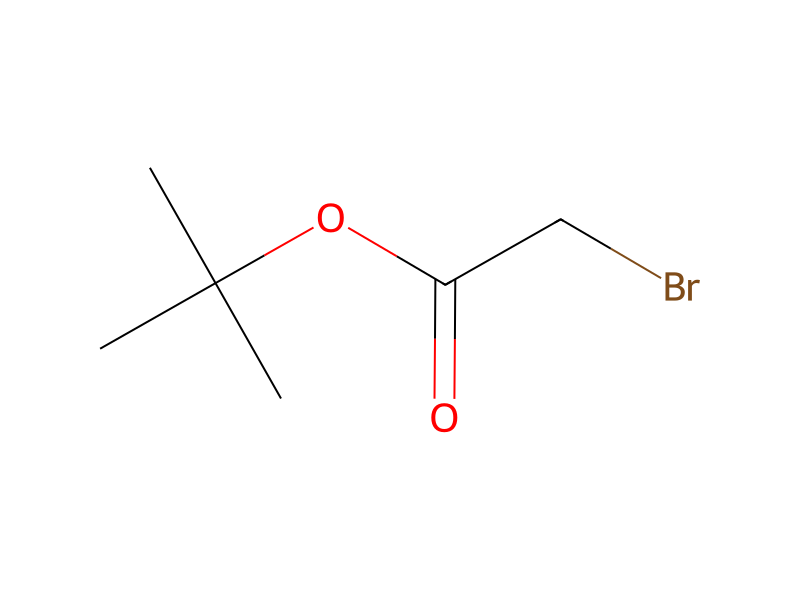
tert-Butyl bromoacetate → 1,2,3,4-Tetrahydro-1,8-naphthyridine
Reaction equation

[N:1]1[C:10]2[C:5](=[CH:6][CH:7]=[CH:8][N:9]=2)[CH:4]=[CH:3][CH:2]=1.BrCC(OC(C)(C)C)=O.[BH4-].[Na+]>>[NH:9]1[C:10]2[C:5](=[CH:4][CH:3]=[CH:2][N:1]=2)[CH2:6][CH2:7][CH2:8]1Participants



Procedure
Scheme 16 illustrates an alternative method for preparing 79 and related analogues 83. Naphthyridine 75 and 82 are commercially available, known in the literature (e.g., Bioorg. Med. Chem. Lett. (1999) 17:2583-86) or conveniently prepared by a variety of methods familiar to those skilled in the art. Naphthyridine 75 is refluxed with benzyl bromide in acetonitrile to give the quaternary salt 76, which is converted to benzyl protected amine 77 upon treatment with sodium borohydride. The benzyl group in 77 is removed by hydrogenation in the presence of palladium on charcoal to give amine 78, which is transformed to 79 using a standard alkylation reaction. Alternatively, treatment of naphthyridine 75 with tert-butyl bromoacetate followed by reduction of the resultant quaternary salt with NaBH4 gives tetrahydro-naphthyridine 80. Deprotection with HCl provides acid 81, which undergoes BOP coupling with diamine 2 to afford 79. By a similar sequence of reactions, 83 is prepared from 1,7-naphthyridine 82.
Workup
- customa standard alkylation reaction
Sources & evidence
- ORD record
- ord-60b990d42bda46fda13278472e0c5ac6
- Source dataset
- uspto-grants-2010_09
- Patent number
- US07795262B2
Reaction notes
Loading…