Reaction equation

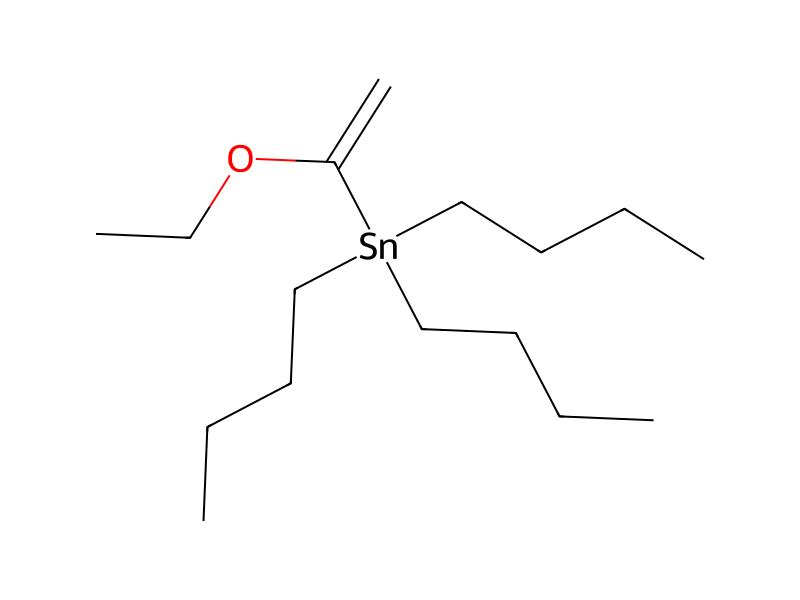
Br[C:2]1[C:3]([F:17])=[C:4]2[O:8][C:7]([CH:9]3[CH2:11][CH2:10]3)=[N:6][C:5]2=[C:12]([C:15]#[N:16])[C:13]=1[CH3:14].C([Sn](CCCC)(CCCC)[C:23]([O:25][CH2:26][CH3:27])=[CH2:24])CCC>C1(C)C=CC=CC=1.Cl[Pd](Cl)([P](C1C=CC=CC=1)(C1C=CC=CC=1)C1C=CC=CC=1)[P](C1C=CC=CC=1)(C1C=CC=CC=1)C1C=CC=CC=1.C(C1(C)C(O)=C(C(C)(C)C)C=CC1)(C)(C)C>[CH:9]1([C:7]2[O:8][C:4]3[C:5](=[C:12]([C:15]#[N:16])[C:13]([CH3:14])=[C:2]([C:23]([O:25][CH2:26][CH3:27])=[CH2:24])[C:3]=3[F:17])[N:6]=2)[CH2:11][CH2:10]1Participants
Reactant 2

Product 1

Reagents, catalysts & solvents 3



Procedure
6-Bromo-2-cyclopropyl-7-fluoro-5-methyl-1,3-benzoxazole-4-carbonitrile (I-77) (8.88 g, 30.08 mmol) was dissolved in toluene (130 ml), then tributyl(1-ethoxyvinyl)tin (11.2 ml, 33.09 mmol) and 2,6-di-tert-butylcresol (66 mg, 0.30 mmol) and bis(triphenylphosphine)palladium(II) dichloride (1.06 g, 1.50 mmol) were added, followed by heating under reflux for 17 hours under nitrogen atmosphere. The reaction liquid was cooled, the insoluble matter was separated by filtration through Celite, the solvent was concentrated under reduced pressure. The resulting residue was subjected to silica gel column chromatography, followed by removing tin-derived side products with n-hexane and by elution with a mixed solvent of n-hexane/ethyl acetate (7:1, v/v) to obtain the a crude product (9.34 g, quant.) as a yellow white solid.
Workup
- temperatureby heating
- temperatureunder reflux for 17 hours under nitrogen atmosphere
- customThe reaction liquid
- temperaturewas cooled
- customthe insoluble matter was separated by filtration through Celite
- concentrationthe solvent was concentrated under reduced pressure
- customby removing tin-
- washby elution with a mixed solvent of n-hexane/ethyl acetate (7:1
Sources & evidence
- ORD record
- ord-bc7ab6ec423e4978a7320d1f5439a7aa
- Source dataset
- uspto-grants-2010_06
- Patent number
- US07737166B2
Linked notes
Loading…