Reaction equation
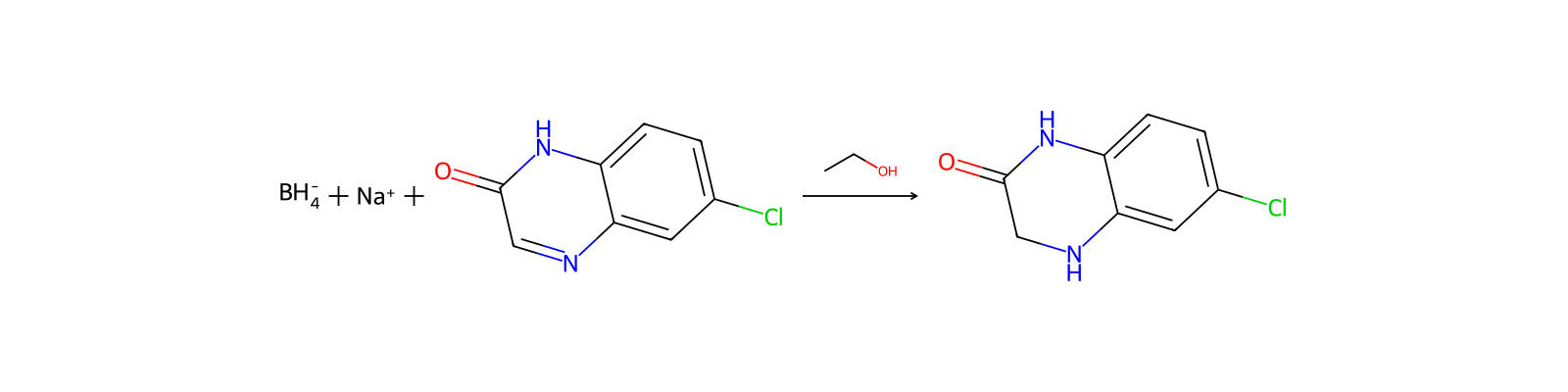
[BH4-].[Na+].[Cl:3][C:4]1[CH:5]=[C:6]2[C:11](=[CH:12][CH:13]=1)[NH:10][C:9](=[O:14])[CH:8]=[N:7]2>C(O)C>[Cl:3][C:4]1[CH:5]=[C:6]2[C:11](=[CH:12][CH:13]=1)[NH:10][C:9](=[O:14])[CH2:8][NH:7]2Participants
4
Reactant 2

Product 1

Reagents, catalysts & solvents 1

Procedure
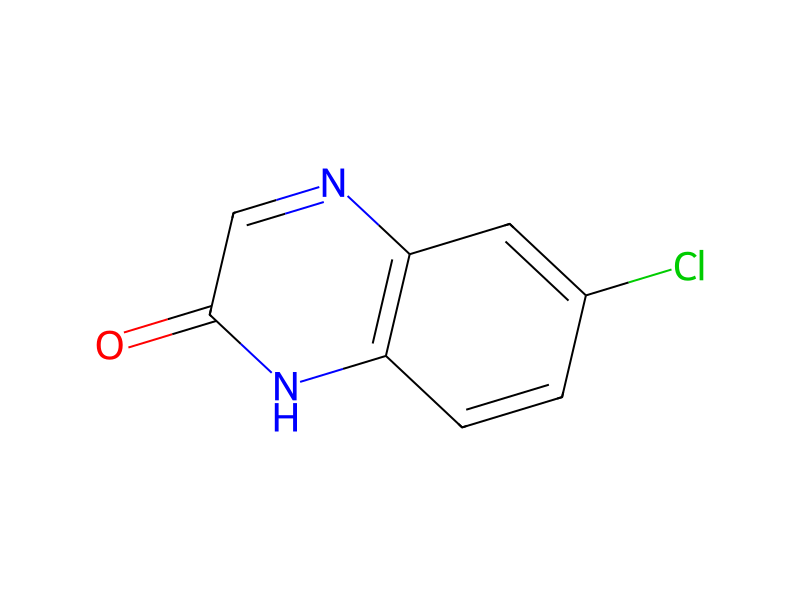
Sodium borohydride (5.10 g) is added to a mixture of 6-chloro-1,2-dihydroquinoxalin-2-one (5.60 g), and ethanol (200 ml). The resultant solution is stirred for 2.5 hr at 20°-25°. The material is partitioned between water and ethyl acetate, the phases are separated, the organic phase is dried over magnesium sulfate and concentrated under reduced pressure to give a solid which is recrystallized from ethyl acetate/hexane to give the title compound, mp 171-174° ; IR (mineral oil) 2953, 2925, 1687, 1517, 1408, 1307 and 1299 cm-1 ; NMR (CDCl3 -MeOD) 6.6-6.8 and 3.95 δ; MS (m/z) 182, 153.
Workup
- customThe material is partitioned between water and ethyl acetate
- customthe phases are separated
- dry with materialthe organic phase is dried over magnesium sulfate
- concentrationconcentrated under reduced pressure
- customto give a solid which
- customis recrystallized from ethyl acetate/hexane
Sources & evidence
- ORD record
- ord-334564f7229047d3a4d3cb41d1f0a55e
- Source dataset
- uspto-grants-1996_07
- Patent number
- US05541324
Linked notes
Loading…