Reaction equation

Cl[C:2]1[CH:3]=[C:4]([NH:9][C:10](=[O:25])[NH:11][C:12]2[CH:24]=[CH:23][C:15](OC(C)(C)C(O)=O)=[CH:14][CH:13]=2)[CH:5]=[C:6](Cl)[CH:7]=1.ON1C(=O)CCC1=O.C1(N=C=NC2CCCCC2)CCCCC1>O1CCCC1>[C:10]([NH:9][CH:4]1[CH2:5][CH2:6][CH2:7][CH2:2][CH2:3]1)([NH:11][CH:12]1[CH2:24][CH2:23][CH2:15][CH2:14][CH2:13]1)=[O:25]Participants
5
Reactant 3


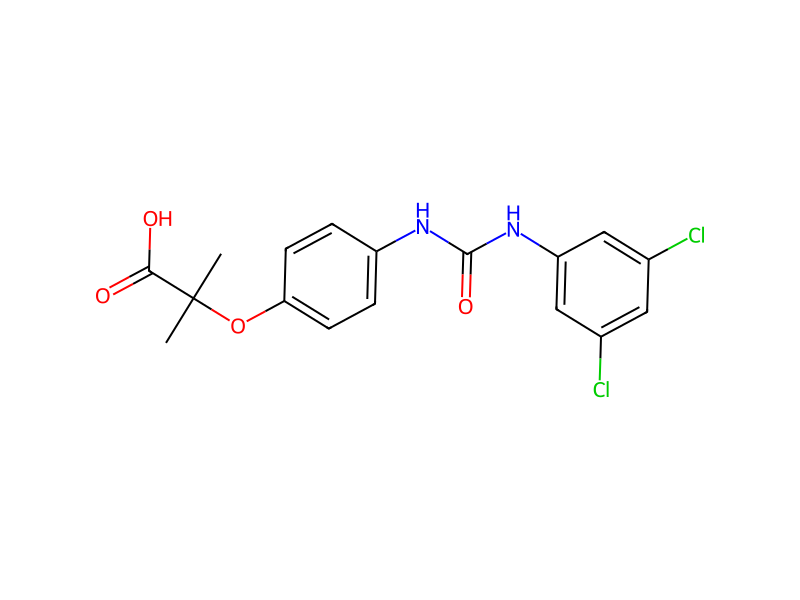
Product 1

Reagents, catalysts & solvents 1

Procedure
A mixture of 383 mg. (1 mmole) of 2-(4-(3,5- dichlorophenylureido)phenoxy)-2-methyl-propionic acid prepared according to Example 4 of U.S. Pat. No. 5,093,367 and 126 mg. (1.1 mmole) of N-hydroxysuccinimide, 26 mg. (1.1 mmole) of dicyclohexylcarbodiimide in 15 ml of tetrahydrofuran was stirred at room temperature for 4 hours, Dicyclohexylurea formed and was filtered off. The solid product was washed with 5 ml of tetrahydrofuran and evaporation under vacuum yielded 450 mg of a powder. mp 106-162° C. The NMR and elemental 2 analysis is consistent with the N-hydroxysuccinimide ester of 2-(4-(3,5-dichlorophenylureido)phenoxy)-2-methyl-propionic acid.
Workup
- additionA mixture of 383 mg
Sources & evidence
- ORD record
- ord-c5affffd330848929cba39fb6951b498
- Source dataset
- uspto-grants-1999_10
- Patent number
- US05962651
Linked notes
Loading…