Nitric Acid → 5-Bromo-2-(2,2-dimethylpropionylamino)-3-hydroxy-6-nitrobenzoic acid
Reaction equation
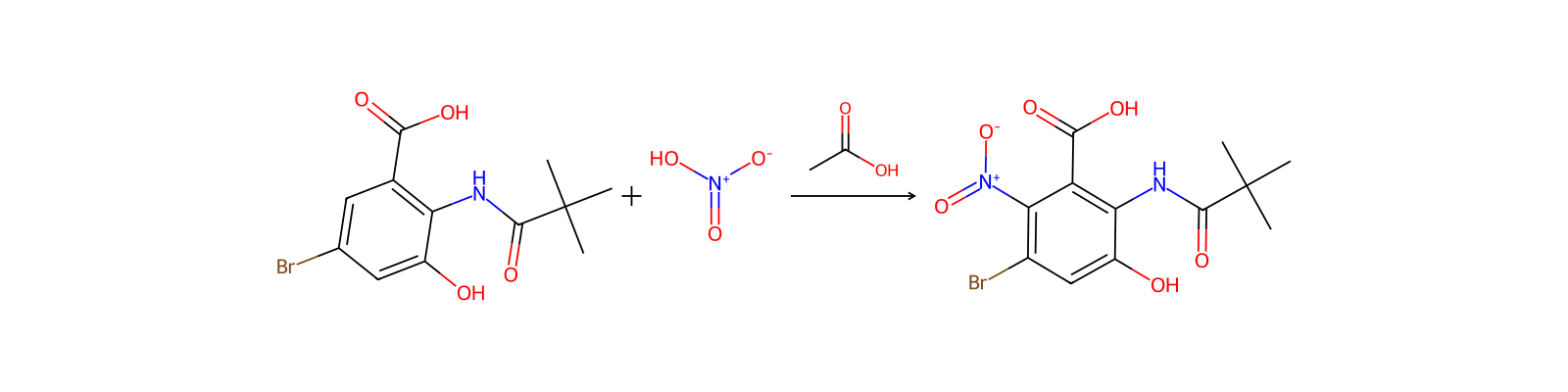
[Br:1][C:2]1[CH:3]=[C:4]([OH:18])[C:5]([NH:11][C:12](=[O:17])[C:13]([CH3:16])([CH3:15])[CH3:14])=[C:6]([CH:10]=1)[C:7]([OH:9])=[O:8].[N+:19]([O-])([OH:21])=[O:20]>C(O)(=O)C>[Br:1][C:2]1[CH:3]=[C:4]([OH:18])[C:5]([NH:11][C:12](=[O:17])[C:13]([CH3:15])([CH3:14])[CH3:16])=[C:6]([C:10]=1[N+:19]([O-:21])=[O:20])[C:7]([OH:9])=[O:8]Participants
4
Reactant 2


Product 1

Reagents, catalysts & solvents 1

Procedure
5-Bromo-2-(2,2-dimethylpropionylamino)-3-hydroxybenzoic acid (I-220) was dissolved in acetic acid (3 ml), then fuming nitric acid (22 μl, 0.52 mmol) was added at room temperature. After stirring at room temperature for 1 hour, the solvent was evaporated away under reduced pressure. The residue was fractionated with ethyl acetate and saturated brine. The organic layer was again washed with saturated brine, and dried over anhydrous sodium sulfate. After filtration, the solvent was evaporated away and the resulting residue was subjected to column chromatography with silica gel, and the fraction with hexane:ethyl acetate=3:1 gave 5-bromo-2-(2,2-dimethylpropionylamino)-3-hydroxy-6-nitrobenzoic acid (61 mg, 36) and the entitled compound (22 mg, 13%).