Reaction equation
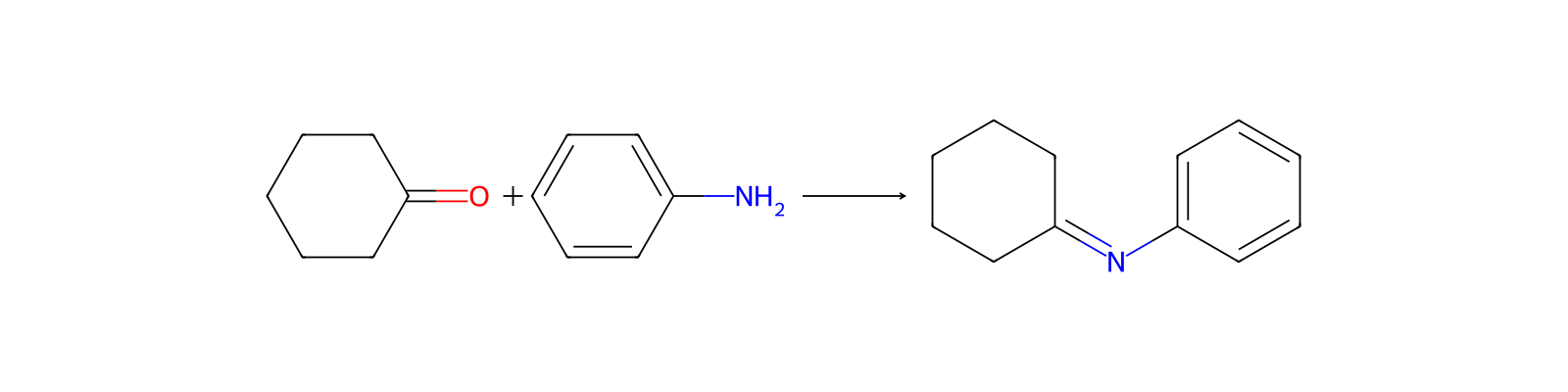
[C:1]1(=O)[CH2:6][CH2:5][CH2:4][CH2:3][CH2:2]1.[NH2:8][C:9]1[CH:14]=[CH:13][CH:12]=[CH:11][CH:10]=1>>[C:1]1(=[N:8][C:9]2[CH:14]=[CH:13][CH:12]=[CH:11][CH:10]=2)[CH2:6][CH2:5][CH2:4][CH2:3][CH2:2]1Participants
Reactant 2


Product 1

Procedure
The dehydrated crude aniline via line 108 can be introduced to and reacted in the reactor 110 to produce a cyclohexanone-reduced product via line 112 that contains less cyclohexanone as compared to the dehydrated crude aniline in line 108. The reactor 110 can be a homogenous reactor where a portion of the cyclohexanone can react within the reactor 110 to produce an imine compound, e.g., cyclohexylidene aniline, as shown in Reaction 2. For example, the cyclohexanone can react with an amine, R—NH2 in the presence of a catalyst, e.g., sulfuric acid, to reduce the cyclohexanone concentration in the dehydrated crude aniline. For example, the concentration of the cyclohexanone in the dehydrated crude aniline can be reduced in an amount from a low of about 10%, and 20%, about 30%, or about 40% to a high of about 50%, about 60%, about 70%, about 80%, or about 90%.
Workup
- customcan react within the reactor 110
Sources & evidence
- ORD record
- ord-195fac41bd254477828adbaacf483240
- Source dataset
- uspto-grants-2015_10
- Patent number
- US09162970B2
Linked notes
Loading…