Nitric Acid → 4,5-Difluoro-2-nitrobenzaldehyde
HRID 1756792
Reaction equation
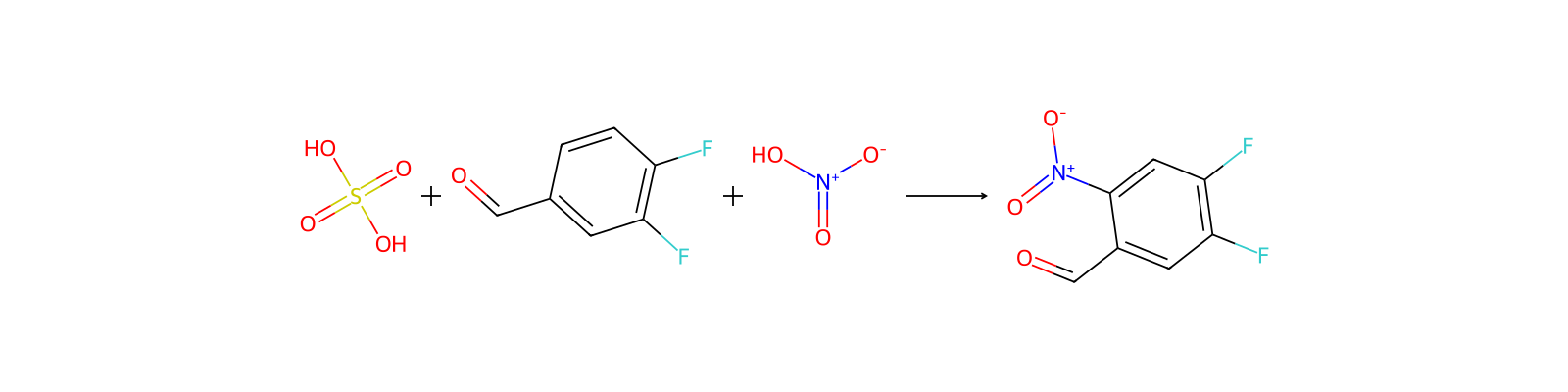
S(=O)(=O)(O)O.[F:6][C:7]1[CH:8]=[C:9]([CH:12]=[CH:13][C:14]=1[F:15])[CH:10]=[O:11].[N+:16]([O-])([OH:18])=[O:17]>>[F:6][C:7]1[CH:8]=[C:9]([C:12]([N+:16]([O-:18])=[O:17])=[CH:13][C:14]=1[F:15])[CH:10]=[O:11]Participants
4




Conditions
- Temperature
- 0 °C
Procedure
To 520 cm3 of sulphuric acid, stirred and cooled to 0° C., 60 cm3 of fuming nitric acid are added in the course of 30 minutes. 100 g of 3,4-difluorobenzaldehyde are added in the course of 30 minutes at approximately 0° C. to the solution obtained. The temperature is allowed to rise to approximately 20° C. and the mixture is stirred for a further 3 hours at this temperature. After cooling to approximately 5° C., the reaction mixture is introduced in the course of 30 minutes with vigorous stirring into 1,200 g of crushed ice. The temperature is allowed to rise to approximately 20° C. and the mixture is extracted with twice 600 cm3 of toluene. The combined organic extracts are washed with 3 times 1,000 cm3 of water and concentrated under reduced pressure (20 kPa) to 50° C. 113 g of 3,4 -difluoro-6-nitrobenzaldehyde are obtained in the form of a brown oil, which is used in the subsequent syntheses without further treatment. A purified sample of 3,4-difluoro-6-nitrobenzaldehyde gives the following characteristics: